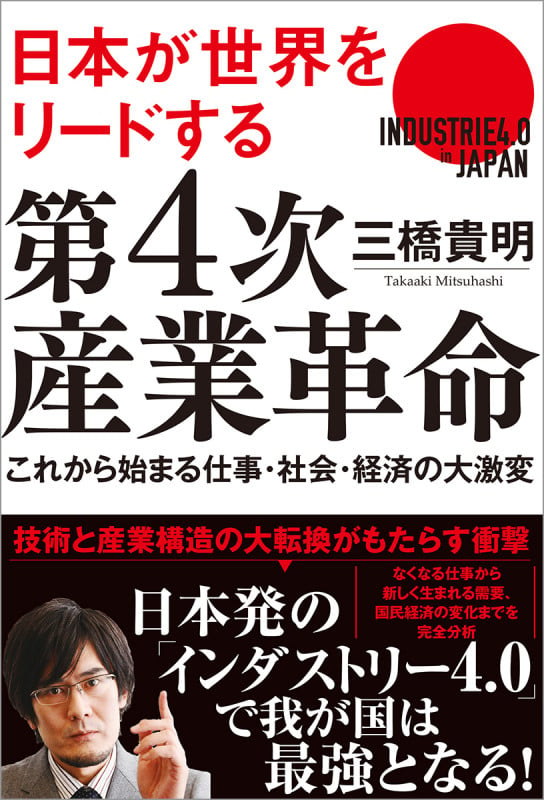
・When the probability that 601 occupations in Japan can be replaced with AI or robots was estimated, estimated results were calculated that occupations with 49% of the Japanese labor population can be replaced after the next 10-20 years (p16). Customers seeking communication with customer service personnel and a sense of luxury will not seek automation/labor saving in ordering and serving meals (p29)
・The Third Industrial Revolution, which used computers and the internet as general purpose technology (GPT: general purpose technology), supported humans with regard to information and increased productivity. On the other hand, the Fourth Industrial Revolution improves productivity by supporting humans in the operation part, and productivity is the amount of added value produced per producer (p31, 39)
・Production, demand, and income are always the same; therefore, GDP is the sum of value-added production, demand = total expenditure (nominal), and is the sum of income generated (p42)
・At road paving sites, humans will be in charge of the “paving work” with the highest added value, and robots will be responsible for “carrying xx” duties other than that (p66)
・It is predicted that medical service systems and service industries that are greatly influenced by human skills, experience, ability, or “ideas” will not be replaced by AI or robots for the next 20 years (p73)
・The so-called world of singularity will arrive, where AI will begin “technology development” without permission, and at some point will begin constructing high-rise buildings with construction methods that humans cannot understand. Futurist Ray Kurzweil says “technical singularity” will occur around 2045 (p76)
・HAL reads biopotential signals from the brain/nervous system emitted when humans try to move their bodies, and the HAL system functions. The brain thinks “it's going to move,” and the brain passes through nerves and sends necessary signals to the corresponding muscles, and muscles can contract according to “intention” to move the joint (p93)
・In HAL medical, electrodes that detect biopotential signals are attached to multiple places on the lower limbs, but for HAL work support/nursing support, electrodes only need to be attached to the lower back, and the installation time is short (p102)
・The drone flies independently to the accumulation site while confirming the position with GPS on the flight route set in advance. Furthermore, the location of the takeoff and landing site of the home is specified using laser light (p107)
・MAIN delivery services are carried out by trucks driven by humans, but drone delivery will be provided from customers that meet conditions such as high costs when humans move, luggage is small, and there is a drone airfield at the delivery destination (p109)
・Massive bridges and tunnels are dilapidated after half a century has passed since construction, and the only way to proceed with inspection work according to law without relying on foreign immigrants is to introduce drones (p118)
・The reason why developing countries cannot easily recover from natural disasters is not because they don't have money, but because they have insufficient economic power to produce goods and services (p136)
・When deflation continues for a long period of time, national income falls, marriages and births decrease, and the birthrate is likely to decline. Like Japan in the Edo period. After the collapse of the Genroku bubble, spectacular deflation continued due to austerity measures by Arai Shiraishi and Tokugawa Yoshimune, and population decline was a result of deflation, not the cause (p140, 141)
・Deflation occurs when an event = bubble bursts, occurs regardless of population trends (p142)
・Debt repayment and bank deposits are neither consumption nor investment; they do not make anyone's income. If the government raises taxes and reduces government spending in this state, it will surely become deflation (p145)
・Production plants and distribution networks were completely destroyed by American air strikes, so even developed countries suffered from inflationary poverty. (p155)
・In the 18th century, England, which was swept by the cotton product “calico” from India, implemented trade protectionism with “India,” which was the largest producer of cotton products at the time, and prohibited the import of Indian cotton products. On top of that, the United Kingdom implemented huge domestic capital investment and technology development investment to improve productivity = carried out an industrial revolution (p158)
・Imperialism used treaties and military power to enforce “free trade” without tariffs or quantity restrictions (p167)
・The abolition of the monopoly system was as expected due to significant interference in internal affairs, so it was settled that there were no restrictions on military goods, rice, wheat, and other products other than grain and copper, which were not approved by the Edo Shogunate (p178)
・Japan accumulated a trade surplus during World War I, and at the end, it was the world's second-largest external creditor country (p179)
・Currently, it is possible to raise funds for 10-year government bonds of 10 trillion yen and issue them at negative interest rates (p217)