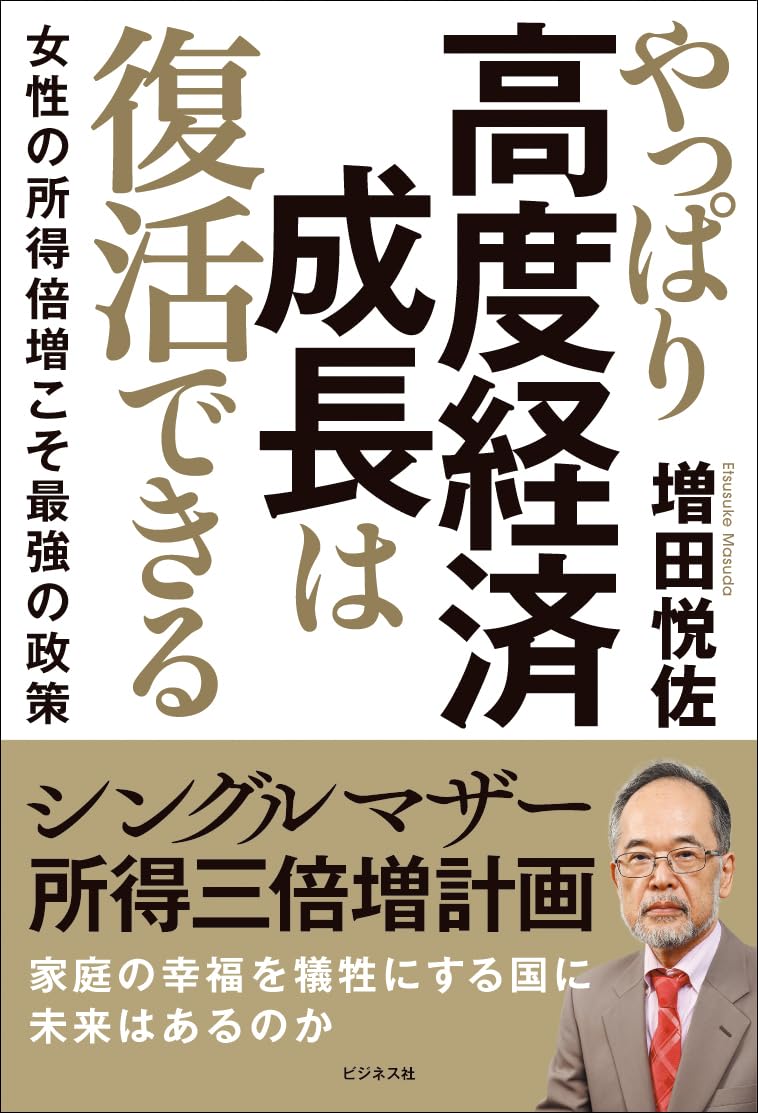
This book argues that there is plenty of potential left in the Japanese economy to revive high economic growth, and that the biggest key to this is to properly utilize the abilities of women who have been forced into low wages and unstable employment until now.
The author first sorts out the meaning of the term active finance. If citizens are simply directing income earned by themselves to consumption, investment, and government spending, then this is not active finance. Borrowing funds from foreign investors and future generations through government bonds, etc., and expanding current spending is said to be the original active finance (p47).
Regarding inflation, it is pointed out that when the price increase rate reaches about 4%, the mentality of “let's buy before prices rise further” works, consumption is brought forward, and there is a risk that price increases will accelerate further. Japan was able to avoid this vicious cycle because the entire population suppressed the speed of money circulation and did not rapidly increase consumption (p54).
However, on the other hand, Japanese households have been forced to sacrifice their finances over a long period of time. Comparing the present with 1994, even though household income has decreased by about 20%, government tax revenue has increased by 43%, and corporate internal reserves have more than tripled. Export companies were able to increase corporate profits because they procured labor and materials that were reduced domestically due to the depreciation of the yen while passing on inflation to prices overseas (p60). In other words, the stagnation in the Japanese economy is due not to companies being able to earn money, but rather because corporate profits have not been sufficiently returned to household income.
As for the foreign economy, Japan is not as weak as is commonly thought. Even when the trade balance became in the red, the primary income balance, such as interest and dividends obtained from overseas investments, maintained a huge surplus, and concerns about the shortage of foreign exchange became unfounded (p69). Also, if concerns about national debt fade and demand for Japanese government bonds increases, yen purchases to purchase Japanese government bonds will increase. Japanese government bonds are issued only in yen, and if US bonds are sold to raise funds, there is a possibility that the yen will appreciate and the dollar depreciate. The fact that GPIF raised the holding ratio of Japanese government bonds has also been introduced as a sign of this (p76).
Even when it comes to energy issues, Japan has great strengths. What is important is not the amount of imports or import destinations, but the amount of energy required to generate a fixed amount of GDP, that is, energy efficiency. Compared to Europe and America, which require large automobiles for everyday travel, Japan can use railways in metropolitan areas and light cars, bicycles, and motorbikes in rural areas. For this reason, the Japanese economy has a structure that is resistant to tight energy supply and demand (p79).
Even so, the author cites underutilization of the female labor force as the biggest reason why the Japanese economy was unable to grow. In Japan, men account for about 70% of the working population and women account for about 30%, and there is a clear gender gap in employment contracts, wages, and employment environments (p91). Japanese women have high basic abilities to work efficiently, such as reading comprehension and math skills, even from an international perspective. Nevertheless, there are many women who completely give up employment or stay working short hours because wages are low and they are not given responsible positions or long-term employment opportunities (p121).
The employment rate for women seems to have risen since the mid-1980s, but the reality was simply a “transition from full-time housewives to part-time, low-wage labor” (p129). When men are regularly employed by large companies, employment until retirement age and fixed wages are guaranteed, while women are less likely to receive equal treatment even if they enter the same company. The author describes the Japanese-style employment system as “a garden where only men are allowed to enter.” The yearly income gap between men and women in Japan is extremely large even among the OECD countries (p137).
Compared to regular full-time workers without children, the gender wage gap in Japan reaches 23%. If non-regular and irregular hour workers are included, the income gap between men and women with children increases by 2 to 3 times (p147). Single mothers are particularly serious. The author suggests that the income of single mothers who work 35 to 40 hours per week should be raised roughly 3 times, with the same pay regardless of whether regular or irregular, if they are in the same occupation and work hours (p175).
The declining birthrate should not simply be viewed as “the number of people giving birth to children has decreased.” The most consistent decline is the birth rate for the first child, and the birth rate after the second child has not dropped much. In other words, the number of children in households that have decided to have children has not changed drastically, and the number of households judging that they “cannot have children economically” has increased, which is the main cause of the declining birthrate (p189).
The author also disputes the common theory that labor productivity in Japan has not increased. Even though productivity per worker is declining, productivity per hour of work is steadily rising. Productivity per person only appears to be low because total working hours have decreased (p200). Productivity per hour rose as a result of increasing the number of non-regular workers and having them perform work with limited working hours, but income and total demand did not increase, and the real GDP growth rate declined (p202).
The author concludes that in order to revitalize the Japanese economy and overcome the declining birthrate, it is essential to create a society where women can work regularly and on time, and to resolve gender disparities in employment contracts, work environments, and wages. Japan is at the worst level among the OECD countries in the five fields of annual income gap between men and women, wage gap between men and women with children, ratio of female researchers, science and mathematics enrollment rate for female students, and the ratio of households where the wife's income is equal to or higher than that of her husband. Not only is this disadvantageous to women themselves, but they are also the “five major disasters” for the Japanese economy as a whole (p243).
Japan still has a foundation for growth, such as external assets, energy efficiency, and high labor capacity. What is necessary to revive high economic growth is not to search for new abilities from overseas, but to give fair employment and rewards to women's abilities that already exist in the country but have not been fully utilized.
summary
After all, high economic growth can be revived