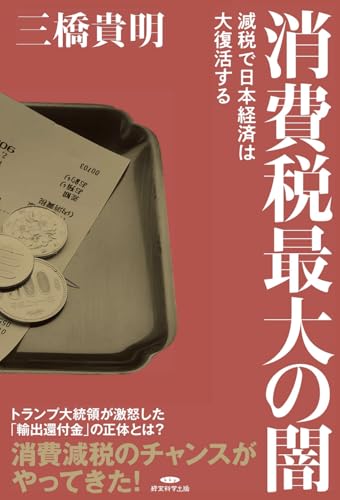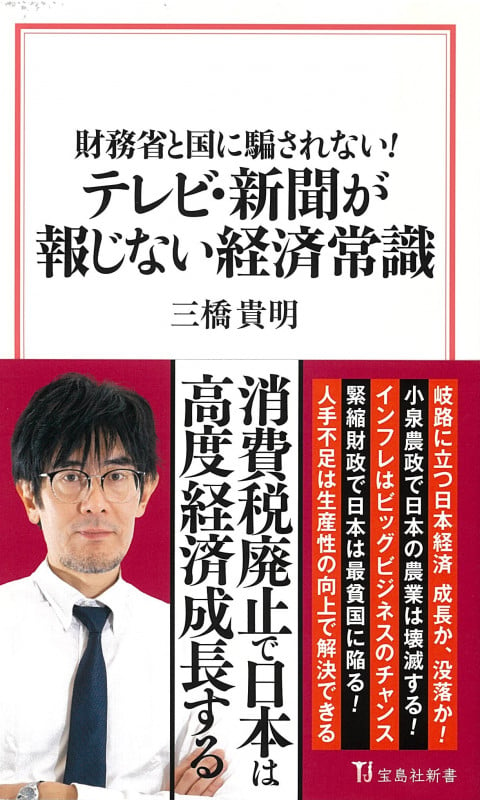
・The tax on products is a destination taxation principle; it is an international practice with the idea that it should be taxed where the product is finally sold; in foreign countries, the gross profit of export companies decreases due to dumping because they sell at a lower price than domestic prices, but since there is an export return tax, the final profit does not decrease (p22)
・The publicly disclosed consumption tax revenue is 24 trillion yen, the amount refunded is 9 trillion yen, and the amount paid by the business operator is 33 trillion yen (p26) Toyota's refund amount for fiscal 2023 is 610.2 billion yen, 71.9 billion yen for the 10th place cannon (p25). The tax revenue of the Toyota Tax Office is negative of 404.4 billion yen, the reason is that the Toyota headquarters is negative (p28)
・Currently, US Trump is attacking each country with tariffs, but from his point of view, it feels like “all foreign companies will export with export subsidies, and conversely, subsidies and tariffs will be applied from here” (p32)
・Consumption tax, which is value-added tax, is different from corporate tax; it is recorded by using a considerable amount of expenses to reduce profits subject to tax; the Ministry of Finance doesn't like this; added value is almost equal gross profit, so there is no business that is in the red (p35) it cannot be taken over, and it can also be taken from small and medium-sized enterprises that don't want to pay corporate tax, so it's called secondary corporate tax (p36)
・If consumption tax is abolished, America will be happy, the export subsidy of 9 trillion yen will effectively disappear, the 10% import consumption tax on imported goods from America will also disappear, and since there will be no 10% that can be called a factual tariff, it will become a big card in tariff negotiations with Trump, prices will also drop, businesses can choose who to let profit, and if the price is lowered, consumers will gain, and if left unchanged, the remaining businesses will gain as gross profit (p44)
・500% inflation in 1946 = prices increased 6 times, the actual value of wartime government bonds became 1/6, but production assets all over Japan were completely destroyed by air strikes by the American military, not due to the issuance of government bonds, so supply capacity was destroyed (p56)
・Welfare pensions peak at 650,000 yen in monthly remuneration, so they are regressive; health insurance premiums peak at 1.39 million yen, and the burden ratio of social insurance premiums decreases as income increases (p63)
・If there is a shortage of labor, it is good to invest in improving productivity, but shareholders dislike such investments, because profits decrease due to depreciation and amortization expenses (p74)
・Real wages peaked in 1997, and prices fell at a pace exceeding that from there until the Democratic Party administration (2009-2011), and wages fell at a pace above that; after the Abe administration, wages were positive, but prices rose at a pace higher than that (p83), when demand was shrinking, taxes were cut to ventilate consumption and investment, and the exact opposite was necessary to increase public investment in 1997 (p85)
・If immigrants are accepted on a large scale, there is no need for investment to improve productivity, and the economic growth rate also falls; the reason why Japan was able to stably continue rapid economic growth of 10% was that immigrants were not allowed in; to be precise, immigrants could not be accepted; the reason was that both Taiwan and South Korea were dictatorships, so economic growth was maintained because they had no choice but to invest in productivity improvement; this is the truth of the period of high economic growth (p119)
・In the future, prices will not fall, and if there is a cost-push price increase, there is a possibility that overall prices will fall if import prices fall, but now, since it is a supply shortage type price increase (p125) if you invest, prices will rise, and if supply capacity decreases without them, prices will rise even more in order to compete for scarce supply (p125)
・Even if you tell Trump that the trade surplus will be reduced, they won't give up, because the problem is that productivity is exhausted, not the amount of the trade deficit (p134)
・Rice soared because the food control system was stopped and the private sector was able to directly trade rice with farmers (p151)
・Government bonds mean the supply of money to citizens by the government, and government bonds of 1300 trillion yen mean that the government provided 1300 trillion yen to private (national) bank deposits. Government bonds are not national debt; they exceed 1300 trillion yen (p171), but compared to 2007, they are 1.9 times smaller compared to Australia 9.5, England 4.1, and over 3 times America and South Korea (p174)
・There is a possibility that fixed exchange rate or common currency member countries that issue government bonds denominated in foreign currencies will go bankrupt, such as Argentina, Lebanon, Greece, etc. (p176)
・This is because foreign countries hold 6.4% of Japanese government bonds, and central banks in each country manage foreign exchange reserves of Japanese yen with government bonds (p182)
・There is meaning in comparing interest payments and GDP, and when comparing this in each country, the lowest in the G7 is negative in Canada. The reason is that Canada has many US government bonds, and since interest income from US international sources exceeds interest payments on Canadian government bonds, the second place is 0.2% in Japan, and the US is 3%, 15 times Japan, and certainly the interest burden is tight financially (p184)
・The total amount of the special account is 430 trillion yen, but there are 222 trillion yen for redemption and refinancing of government bonds, 90 trillion yen for transactions between accounts, and 80 trillion yen for social insurance benefits; these cannot be included in the general account, so the rest is only 1.9 trillion yen for energy measures, 1 trillion yen for food stability supply special accounts, and 100 billion units (p208)