・The process by which someone's expenses become someone's income is called the real economy. In the real economy, production, expenditure (demand), and income are always equal. Also, the total domestic production is called gross domestic product (GDP). GDP is actually the sum of production, and at the same time, it is also the sum of demand and income. Countries with growing economies are judged to be rich because “total income” is expanding rather than production (p17)
・Banks issue money called bank deposits by increasing the number of deposit amounts in the borrower's bank account in exchange for loan certificates, so-called credit creation. Money called bank deposits is created by loans (loans) from banks. Conversely, it disappears when it is repaid (p19) Loan repayment to banks is neither consumption nor investment, in other words, even if money disappears from our hands, it doesn't become anyone's income (p22)
・The Japanese economy plunged into full-scale deflation in 1997, and the beginning was the burst of the bubble around 1991. Japan's economy deflated due to the burst of the bubble and fiscal austerity measures (consumption tax hike = reduction in private consumption, reduction in demand by public investment = reduction in public fixed asset formation, etc.) due to the collapse of the bubble in 1997, and GDP entered a situation where GDP did not grow at all, deflation is a shortage of total demand, and there is a shortage of spending on consumption and investment (p21)
Deflation is an economic phenomenon in which GDP, which is the pie of production, demand, and income, becomes smaller. Prices certainly fall precisely because demand withers = fewer buyers. However, by no means is deflation = falling prices; deflation = reduction in demand is correct. A contraction in GDP is the same as a fall in income, and a fall in income will reduce the next demand. People whose salary has decreased try to reduce consumption, which means that the next demand will shrink (p24)
・The reason why the Japanese economy is not growing at all is not because we Japanese are not making any efforts. This is simply because the lack of aggregate demand called deflation has not ended. When demand is insufficient, companies do not invest, and households do not consume because real wages fall. Demand for investment and consumption does not increase, that is, if expenditure does not increase, producers' income is suppressed; production = expenditure = income. The private sector where income does not increase naturally does not increase spending, so the shortage of demand will not end (p26)
・The economic phenomenon of deflation, where demand is insufficient, cannot be solved by economic agents (private sector) that are forced to act rationally. In order to overcome deflation, the power of a government capable of irrationally expanding spending is necessary. However, since the government itself reduced demand for public investment, and furthermore repeated consumption tax increases to suppress demand for private final consumption expenditure, it suffered from deflation over a long period of a quarter century (p28)
・When the elderly receive medical care or nursing care, it means that the elderly spend on medical services and nursing care services, and the government is paying for them. Whether the elderly are self-sufficient or the government pays, there is no change in the fact that medical services and nursing care services are produced and income is being generated. However, pensions are a transfer of income from the government to the elderly, and since the government is not purchasing goods or services, demand (GDP) does not directly increase (p31)
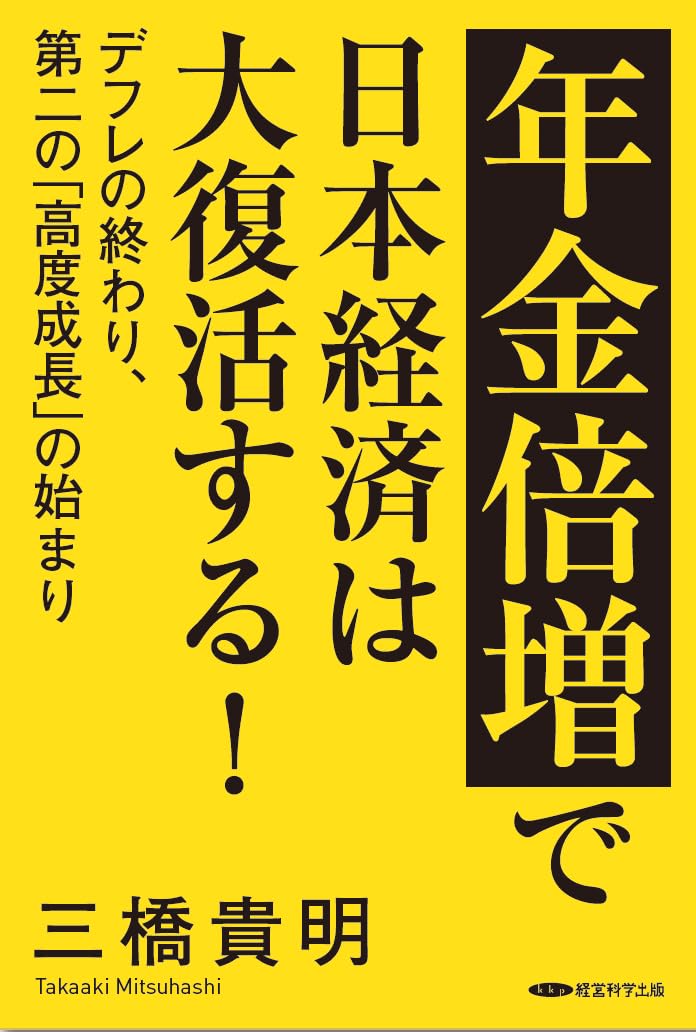
・Countries with deflationary gaps do not grow economically. The reason for Japan's rapid growth is not because the population was growing; the rate of increase in Japan's total population at that time was only about 1% every year (about 1.7% even for the working-age population). Japan's dependence on exports during the period of high economic growth never reached 10%; incidentally, Japan's dependence on exports in 2020 was 12.7%. What brought about rapid growth in Japan was an “increase in productivity,” which is not an exaggeration in human history (p38), in other words, an inflation gap where total demand exceeds supply capacity and investment to improve productivity are the key to economic growth; in other words, the government needs to expand spending (government final consumption expenditure and public fixed asset formation) until total demand is in an inflation gap state where total demand greatly exceeds supply capacity, or expansion of private sector consumption Consumption tax reduction or abolition that induces consumption tax, and furthermore, pensions should be increased to increase consumption for the elderly (p41)
・If the price of materials and services produced by producers rises, income also automatically increases, and if the unit price rises by 10%, producers' acquisitions also increase by 10%. However, the case where producers of goods and services are foreign countries is a different story; it is foreign producers who increase their income when prices rise, not Japanese citizens. Even if deflation continues and Japanese citizens are still suffering from falling incomes, prices rise due to rising import prices, which is what is called cost-push inflation. In contrast to this, in Japan during the period of rapid growth, prices rose in a manner driven by demand, and this is called demand-pull inflation. In this case, prices will certainly rise, or at least the acquisition of citizens will definitely increase. There is only one thing the government should do in cost-push inflation, which is to expand demand for domestic consumption and investment; if pension payments are raised, demand will definitely increase and the deflation gap will disappear (p46)
・Russia and Argentina have defaulted on government bonds denominated in their own currency, but both countries adopted a fixed exchange rate system, and in this case, national bonds denominated in their own currency become dollar-denominated government bonds. Russia's trade balance deteriorated rapidly due to low crude oil prices, and Argentina's trade balance deteriorated rapidly due to exchange devaluation in Brazil, the main export partner country, and when the trade deficit expanded, the exchange rate from one's own currency to the dollar increased dramatically, so the government had to withdraw foreign exchange reserves and continue to buy back its own currency, and eventually, reimbursement or interest payments became impossible, leading to financial bankruptcy (p61)
・According to the Cabinet Office's estimation, it seems that they thought it would be impossible for the overseas deficit (surplus of Japan's current account balance) to expand beyond what it is now, and it is a simulation where PB surpluses are achieved by reducing private sector surpluses. There is no doubt that the Japanese government, which has strong preferential treatment for large enterprises and the wealthy, will force sacrifices on the private sector, leading to policies that make the majority of ordinary citizens impoverished even more than they are now. Specifically, it is the imposition of increased burdens on households, such as consumption tax hikes, increases in social insurance premiums, and increases in copayment of medical expenses, and in addition, further cuts in various government spending. As long as the government has a PB surplus target, we only have a future where we will be poor (p76)
・The Japanese government's debt balance (as of 2015) is 37.4 million times that of 1872 in nominal terms, and 546 times that of 1885 in real terms. The reason why government debt has increased so rapidly is that the productivity of the Japanese economy increased and production volume increased after the Meiji period. If the government did not issue money, Japan would always fall into a situation of deflation and the economy would not grow (p81)