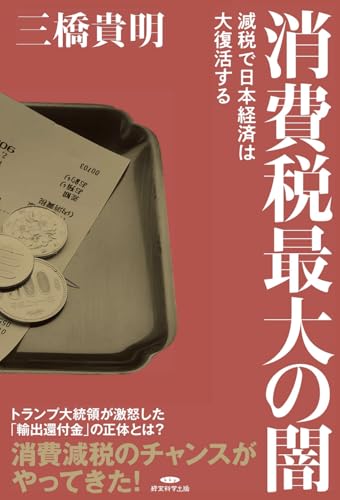
・The essence of consumption tax is an export subsidy and at the same time a tariff on import costs. Of course, there is no doubt that the Ministry of Finance had feelings of resentment against small and medium-sized enterprises that do not pay corporate tax, and at the same time, they probably wanted stable financial resources. However, in fact, it was Keidanren that most desperately sought the introduction of consumption tax (p2)
・Consumption tax was successfully introduced for the purpose of collecting factual corporate tax even from businesses whose final profit (= profit before tax) is in the red, but this brought ridiculous profits to major Japanese export companies (p7) Consumption tax borne by undercooked enterprise groups is handed over to export companies as “export return tax” (p19)
・The most recent export return tax is 9 trillion yen per year, and consumption tax revenue is on the scale of 24 trillion yen. This means that the actual total amount of consumption tax is 33 trillion yen, of which 27% has been returned to export companies, and what is frightening about this system is that export subsidies increase as the consumption tax rate is raised, such as export return tax (p24)
・Japan's consumption tax law applies a “0% consumption tax rate” to export companies based on the theory that “even if consumption tax is raised domestically, prices cannot be raised abroad, and consumption tax cannot be kept from consumers.” This premise was necessary because consumption tax was an “indirect tax received from consumers,” and furthermore, when the assumption that “it cannot be deposited from foreign consumers” collapsed, it was viewed as a problem to refund export return tax to export companies (p29)
・Even if consumption tax is raised within Japan, or even if foreign countries raise tariffs, the price competitiveness of Japanese companies' exports will increase if the exchange rate moves to depreciate the yen (p30)
・The high consumption tax rate in European countries is the result of raising tariffs and export subsidies against each other, and as Piketty saw, it is unrelated to social security financial resources, etc., and since it is also imposed on imported products, consumption tax is the tariff itself (p51)
・Economic deflation and panic due to excessive free trade and globalism caused World War II, but after the war ended, the wrong perception that “protectionism in each country caused World War II” was shared, and as a result, free trade agreements such as GATT were born and renewed. In reality, it is impossible for each country to accept free trade unconditionally, and the deception of “value-added tax” The tax system of was born (P57)
・In the case of major export companies, export return tax increases ordinary profit as non-operating income, in other words, raising consumption tax contributes to maximizing net profit through these three routes: reducing labor costs, lowering corporate tax rates, and miscellaneous income such as export return tax (p60)
・The government is not the source of the export return tax. Consumption tax paid by the value chain below the subcontractor (p63)
・In official documents of the United States of America, value-added tax (= consumption tax) refunds are not called refunds (refunds); they are called rebates. Debate has the meaning of a subsidy or sales incentive in English. America, which is the only country in the world that has not introduced value-added tax, recognizes that Japan's export return tax and global value-added tax refunds are simply export subsidies (p66)
・The real aim of the Ministry of Finance, which strongly promoted the introduction of invoices, is not an increase in sales of 248 billion yen; first, if the export return tax must be “export return tax = purchase tax amount,” it is necessary to clarify the consumption tax amount at each stage of the value chain using the invoice, and furthermore, there is a possibility that it is aiming to “raise the overall consumption tax rate after setting it to multiple tax rates” ( Intense (similar to Europe) (p86)
・Special accounts are simply “separate accounts,” and budgets that use financial resources other than general account revenue, such as social security benefits and local grant tax grants, are simply processed in separate accounts (p101)
・A consumption tax rate of 0% on foodstuffs is not useful for negotiations with the Trapp administration, because Japan hardly exports food to America (p130)
・If the consumption tax rate for foodstuffs becomes 0%, restaurants will not be able to receive purchase tax credits. This is because grocery purchases move from “expenses with invoices” to “expenses without invoices.” As a result, taxable purchases will decrease, and there is a possibility that restaurants and consumption tax hikes will increase (p132)