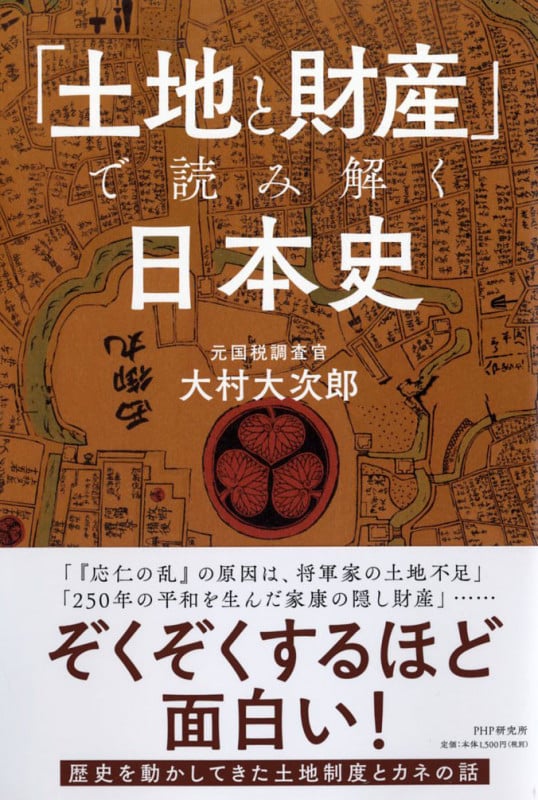
・The only government in Japanese history that did not recognize intellectual property of land was the Yamato administration after the Taika Reform (p16)
・The Mina region of the Korean Peninsula controlled by Japan was a national burial site that occupied about half of present-day Korea, and was also taken under the control of Silla, but Japan gave it to Silla on the condition that signs were received from Silla, and Japan's influence was maintained, and Baekje was also dimmed by Japan, and ancient Japan had Baekje and Silla as middle vassals (p19)
・After the landlord's renovation, they were given fields, and if they paid a tax of about 3% of the harvest, the rest of the harvest became their own. This was much easier compared to previous exploitation of ruling families, so life stabilized and labor force increased (p35)
・The allied forces of Tang and Silla advanced to Baekje, which had formed an alliance with Japan; Baekje collapsed and the remnants of Baekje requested relief from Japan, where the Japan/Baekje allied forces and the Tang and Silla allied forces clashed at Baekchungang (p37) Since they lost this battle, it became impossible to import iron ore from the Korean Peninsula, and only iron sand began to be used from the latter half of the Nara period (p39)
・Manors proliferated rapidly from the latter half of the Nara period to the Heian period, and became one cause of the collapse of the Imperial Court administration. At the beginning of the manor house, the imperial court was short of financial resources. The Imperial Court issued the Sansei Isshin Law in 723 in order to induce the people to voluntarily cultivate new rice fields. There was an outbreak of smallpox in 735-737, and over 20% of the 1 million people at that time died, and Emperor Shomu asked Shinto and Buddha as a way to overcome this. Kokubunji and Kokubunniji were built all over Japan, and it was decided to build the Great Buddha of Todai-ji Temple in 743. What was conceived as a financial resource was the “Kenta Naganen Private Finance Law” (p43)
・From the middle of the 9th century, when the creation of family registers became ambiguous, the authority of the kokushi became extremely large, and since there was no clear family register, tax collection amounts etc. were determined by national examination judgments (p54) In the 10th century, military recruitment determined by the ritsuryo became difficult, and the method of conscription was also left to the kokushi, so the kokushi secured it as a military force by handling local ruling families, etc. It became (p59)
・Around the time of Taira no Kiyomori, Japan-Song trade flourished, and Tsuruga Port at that time was the base for Japan-Song trade after Hakata, and Kiyomori built Yamadadomari (Kobe Port), which is a trading base in “Hyogo,” which is much closer to Kyoto than Hakata (p65)
・In the old national system, it was the imperial court that mobilized groups and led wars, and merit was performed by the Imperial Court, Minamoto Yoritomo changed this rule, managed and oversaw the bushidan, made the Imperial Court unable to talk about the samurai group, eliminated the influence of the Imperial Court by separating samurai families from the Imperial Court, and acquired “tax collection rights, military power, police power, right to place a protected ground, etc.” (p68)
・This is because Minamoto no Yoritomo prohibited each samurai family from coming into direct contact with the Imperial Court, and if samurai families were taken into the Imperial Court, the idea of a new government by the samurai group would collapse from the ground up. My younger brother Yoshitsune destroyed this important premise (p70)
・The financial resources of the Kamakura shogunate were nothing more than taxes obtained from land under direct control and complete trade. The Kamakura shogunate had two types of territory; one was called the “Kanto Gobu Province,” and they appointed Goken and others as national governors and governed that region through a national government office (local government office). Suruga, Musashi, Sagami, and Echigo were targeted, and depending on the season, Totomi and Izu were also included. The other is called the “Kanto Goryo,” and it is under the direct control of the Kamakura Shogunate, and in 1184 Minamoto no Yoritomo was granted 500 former territories of the Taira clan by the Imperial Court. The Kamakura shogunate ruled only a few countries centered around the Kanto region, and Japan was ruled by local ruling families in each region as a whole (p73)
・The reason for the instability at the time of the Onin War was that the Muromachi shogunate had few territories under direct control and weak financial power, and there were few territories directly under the direct control of the Kamakura Shogunate, which was a samurai government, but the Muromachi shogunate had even fewer, and it was around 2 million koku even when estimated by Omi (p78)
・The 70,000 yen coin that Hino Tomiko is said to have accumulated is 4 billion yen or more in modern currency value. This is certainly large if it is personal savings, but it is not a large amount of money at all when viewed as an asset of the shogunate. For example, Uesugi Kenshin had 40,000 cans per year with only customs revenue from the two ports of Kashiwazaki and Naoetsu (p85)
・In Kii Province (Wakayama Prefecture), about 90% of the paddy field area is said to have been the territory of temples and shrines, and in Yamato Province (Nara Prefecture), there was no land that was not the territory of Kofukuji, Todaiji, Todaiji, Tomine, Koyasan, and Mount Kinpu (p93)
・Actually, Oda Nobunaga carried out bold farmland reforms and implemented “big tax cuts” for the people of his domain. Nobunaga rapidly expanded his territory while fighting against surrounding forces, and smooth territorial expansion was not possible without gaining the support of the people of his domain. Nobunaga was able to rapidly advance the nation unification project because his country's governance went well compared to other feudal lords (p105)
・Judging from the records left behind, Oda Nobunaga was not the Seii Taishogun, but the Grand Minister of State (in charge of administration in the Imperial Court) (p111) Nobunaga was trying to return to a form where “the central administration rules the whole of Japan” (116)
・The territory under the direct control of Tokugawa Ieyasu was different from Toyotomi Hideyoshi's 2.2 million koku, and after the Siege of Osaka there were 4 million koku, and the Tokugawa family as a whole had 8 million koku (p149)
・Farmland nationwide was measured for land tax reform in the Meiji period, and according to Edo period records, the harvest amount in Japan was 32.22 million, but it was found that there were actually 46.84 million koku (p177)
・The Meiji government, which won the Boshin War, had direct control of a total of 8.6 million koku, but there were no financial resources at all, and they wanted to collect taxes from all over the country as a centralized administration, so there was a movement to abolish feudal domains and establish prefectures (p190)