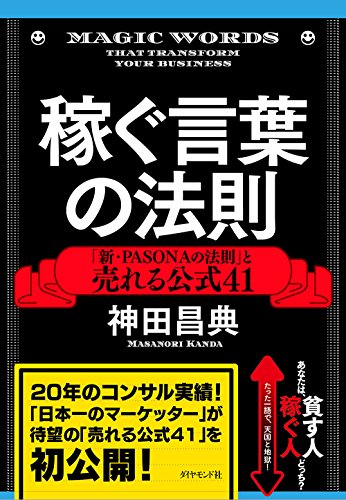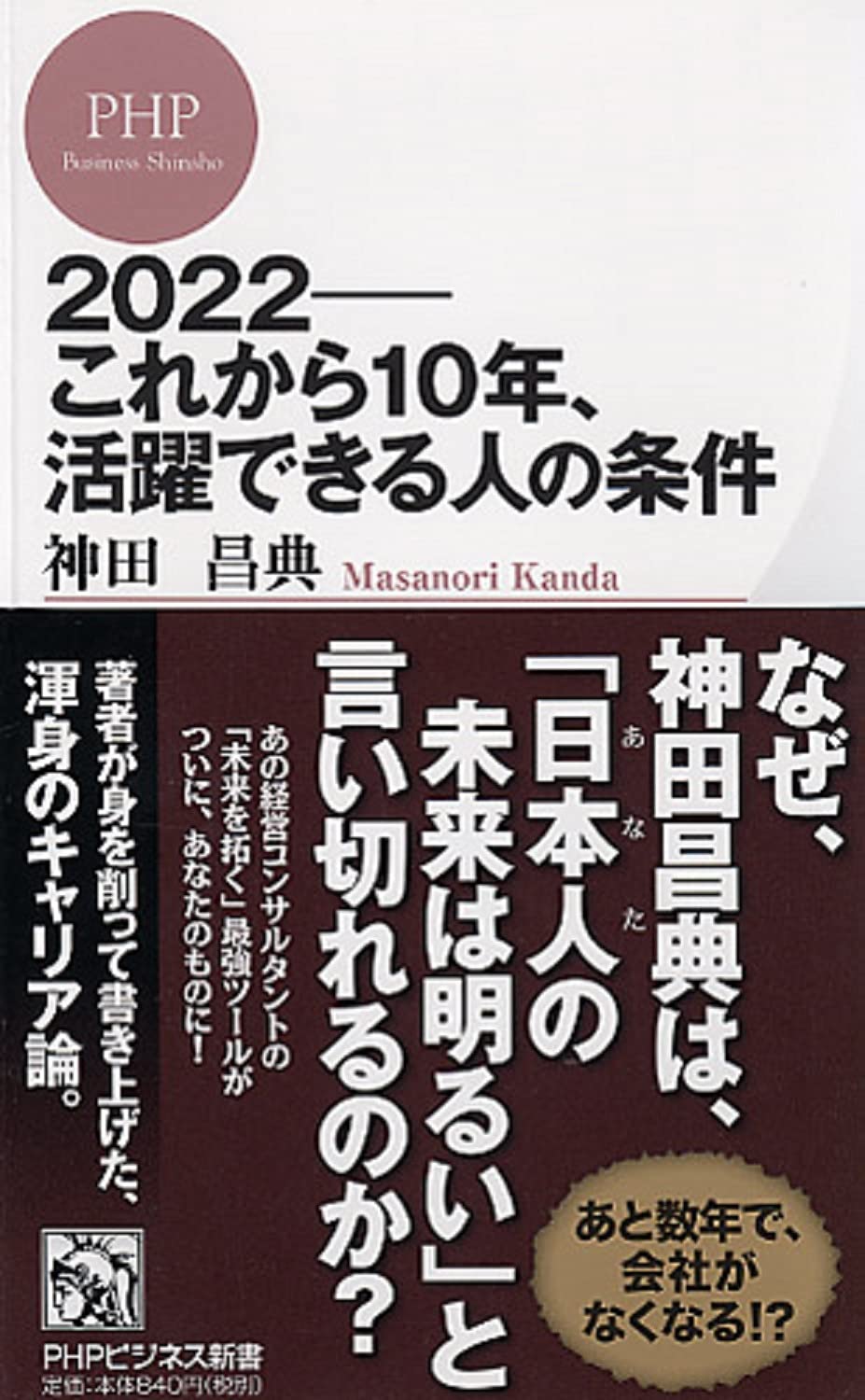
The book, which drastically changed my way of thinking up until then by reading that book, is 3 stars (the highest score of 5 stars in the booklog evaluation) in my review evaluation, and this book falls under that.
I think I've been reading Kanda's books about 20 years before I became a member of society, but as he wrote in his book, this is the first book to predict the future of Japanese society. These predictions are based on growth curves often used in marketing and the “spring/summer/autumn/winter theory” he compiled in his book about 10 years ago, and it seems that Japanese history is similar when viewed on a 70-year cycle.
There is probably an error of about a few to 10 years (although this has a big impact on my age), but I felt that the direction was as Mr. Kanda pointed out. I'm following him on Facebook for this book, so I was able to read up to 2 chapters on the web, and I was shocked.
Our ancestors had gone through the experience that their way of thinking up until now didn't work, so I decided to follow their example and be prepared to swim through on my own without drowning.
Below are the points I was concerned about.
・The future is a choice, and it is realized by will; no matter what kind of unexpected obstacle appears in front of us, it does not shatter the future we envision; it is an entity that accelerates it (p26)
・History is not created by a series of random events; it is created by repeating the same pattern of stories (p29)
・If you understand how history is created, you can also understand how the future will be created (p37)
・By touching the baton, 4 generations (ambition, power, commerce) will create a single historical cycle over 70 years (p38)
・After 2007, we are in a period of dialogue to create a new era beginning in 2015 (p44)
・The cause of the collapse of civilization is not war, disease, or food crisis; when history is about to reach a major turning point, the difference between whether “values to be inherited” and “valuations to be discarded” could not be determined, what can be done evolves, and what cannot be destroyed (p45, 134)
・Due to the current earthquake (311), the Japanese archipelago moved and tilted in the southeast direction, so further earthquakes will occur to correct for that, and another 34 years (p55) will occur when the Great Hanshin Earthquake starts
・"Okage Mairi” in the Edo period began in 1867/8, and quickly settled down when the monarchy was restored in December (p65)
・If many leaders who love the region are born and the local community becomes stronger, earthquakes and sacrifices can be minimized (p71)
・Speaking of Mr. Dent's prediction method in extreme simplification, the economy is determined by an increase or decrease in the 46-50 age population, because it is the age where people spend the most money in their lives (p87)
・Today's China is 35-44 years old and has large mountains, so the Chinese economy will grow significantly until 2020-25 (p90)
・The market that supports innovation in an aging society is shifting to an aging population, and Japan is amazing (p107)
・The iPhone was introduced for 3 years from 2010/6 to 2007/6, and if you understand this, you can see that the end of the growth period is 2013/6, and the end of the maturity period is 2016/6. The 4S that went on sale in 2011/10 is a product (p126) right in the middle of the growth period
・When the life cycle of each model becomes one-third of the longest period, it is a sign that they are late in life (p132)
・When looking up the life span (heyday) of a company, the 1970s: 50 years, 1983:30 years, 1997:12.5 years, 2008:10.5 years, 2008:10.5 years, the life span of a company will almost end in 2024, and the form of capitalism will end around this time (p137)
・If employees cannot gain valuable experience, hands and feet remain in an organization where there are only heads and limbs, and the reason why mid-sized companies have a crisis saying “it is not strange if the company disappears in ten years” (p145)
・As advice given to my son by a 48-year-old author, 1) study abroad, 2) English, and 3) Chinese (p158)
・Why can foreign sumo wrestlers speak Japanese, and why can street souvenir sellers be able to speak Japanese because they limit what they speak (p160)
・Reality changes depending on how you look at things; it's different whether you capture the present as an extension from the past, or whether you capture reality by calculating backwards from how it should be from the future (p176)
・Obtaining information has been emphasized in learning up until now, but that changed decisively at the end of 2008, when the internet penetration rate reached the upper limit (p182)
・The four growth stages brought about by reading sessions are Information (improving individual abilities), Interformation (getting to know yourself within a team), Exformation (starting to create your own world outside), and Transformation (connecting with people who empathize) (p195)
・The changing times mean that there will be a gap between everyday life up until now (p211)
・After the East Japan Earthquake, what customers are looking for changed to a “sense of closeness with customers” such as “empathy,” “kindness,” and “connection” (p226)
・There is no risk in a job you can really be passionate about (p238)
・There are 12 stages of life every 7 years: Innocent, Orphan, Warrior, Caretaker, Explorer, Destroyer, Lover, Creator, Ruler, Magician, Sage, Fool (p249)

![人もお金も動き出す! 都合のいい読書術 [新書版]バカになるほど、本を読め! (PHPビジネス新書) photo](https://suu3-media.s3.ap-northeast-1.amazonaws.com/media/portal/prod/uploads/blog/booklog/1-99583550.jpg)