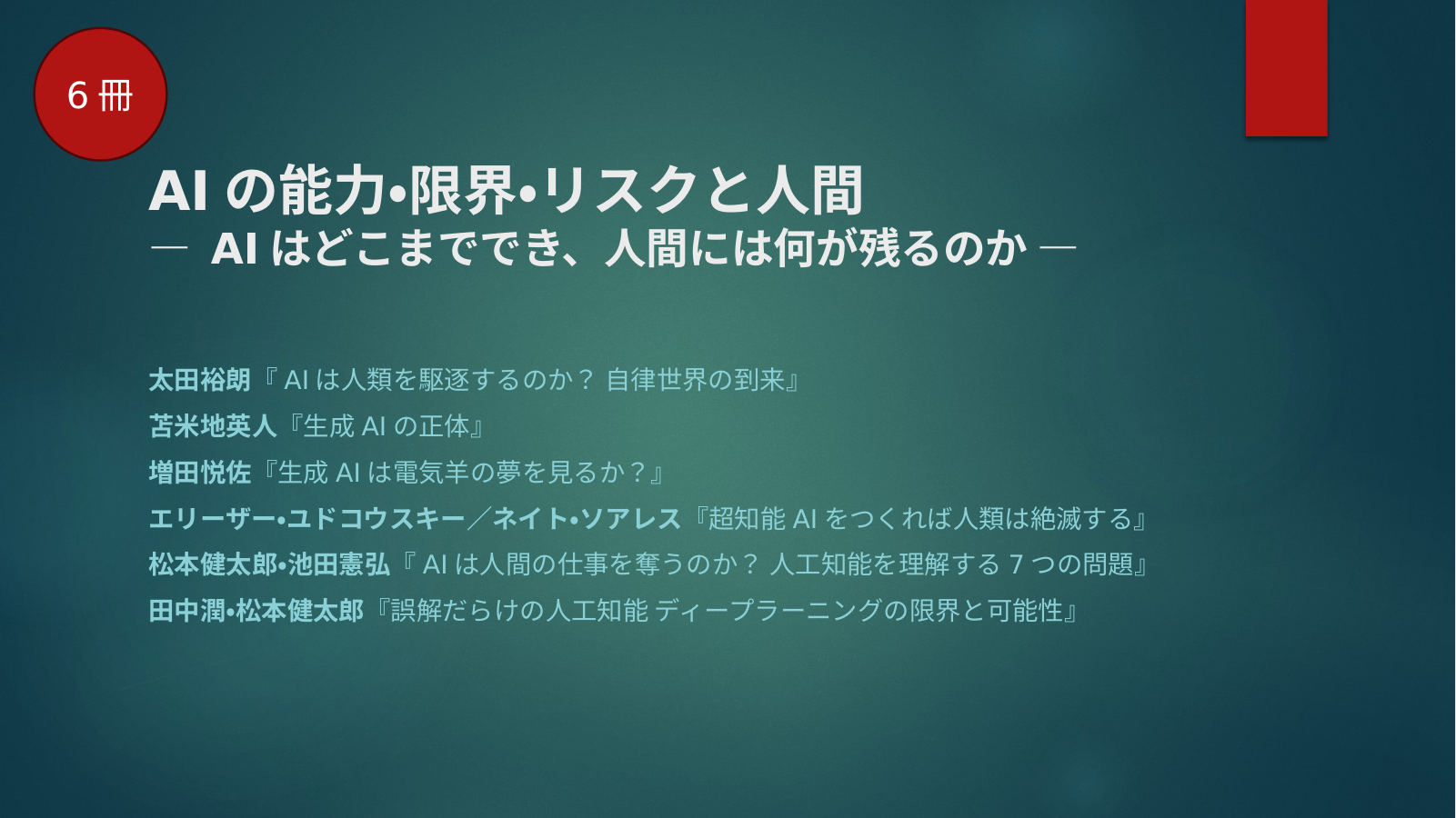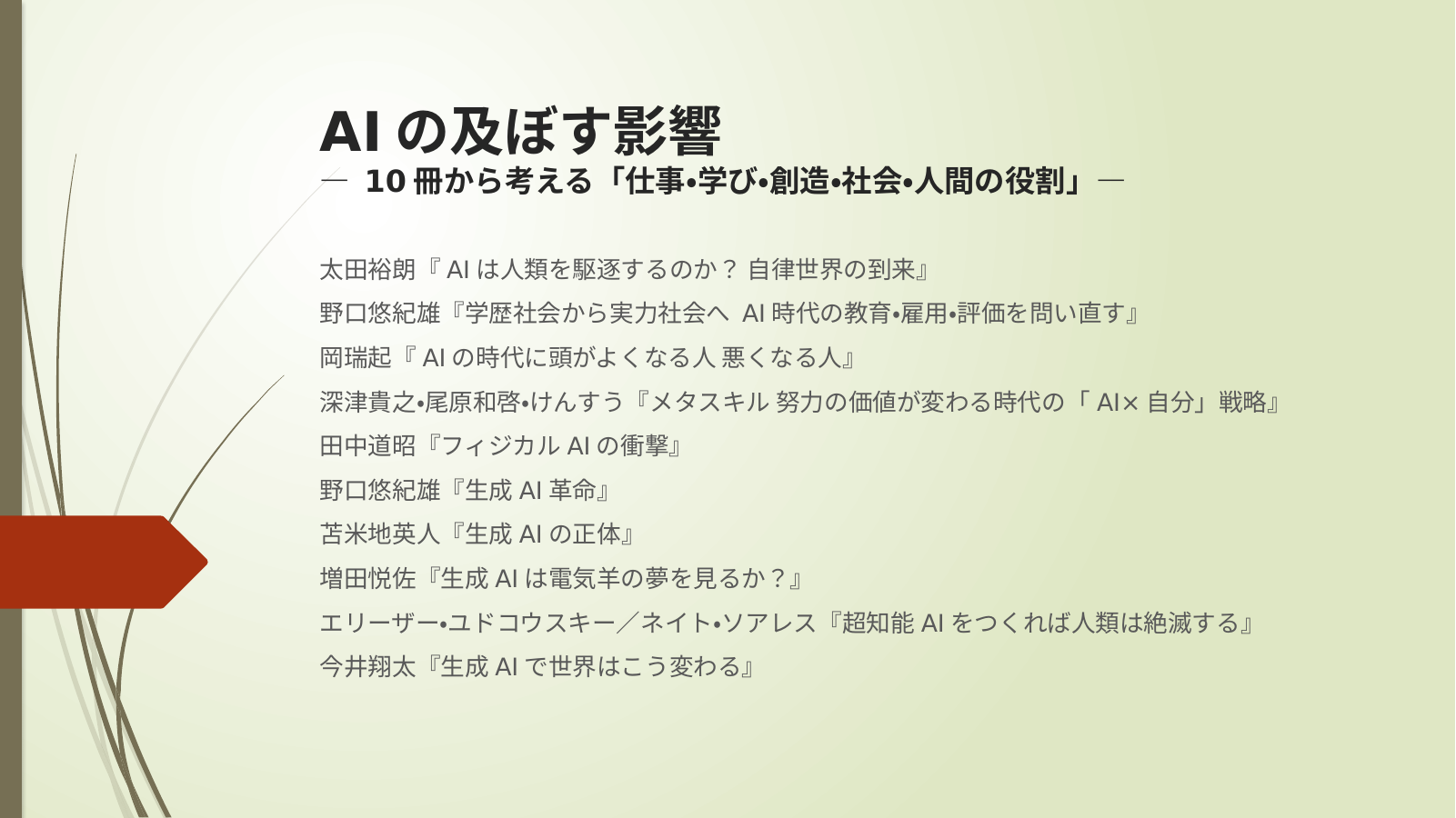
・ What is AI good at? It is instantaneously summoning and presenting all knowledge from around the world. In the AI era, you must not compete where AI excels the most, and what you should do the least in the AI era is “study” (p9)
・What we are going to do from now on is “create something that didn't exist in the past”, something AI can never do (p10)
・Humans choose words by understanding meaning, generative AI selects words with high probability, that's why generative AI causes halcination (hallucination), and it is natural to make mistakes if you select the next word based on probability alone (p13)
・Generating excellent knowledge and problem solutions that exceed individual limits by integrating and systematizing knowledge, information, and experiences brought by many individuals is called “collective intelligence,” and generative AI does not perform collective values. If a large number of individuals gather and bring wisdom, a conflict will only occur, and this is the conclusion that generative AI makes (p35), using a method called majority vote to avoid this (p35)
・Generative AI is fiercely competitive for user acquisition by several companies, but what is becoming important is not the “accuracy” of generative AI, but “humanity,” and it naturally gives some kind of answer to human questions without hesitation, and establishes conversations by answering them in a reasonable way even if they don't understand. The company thought this was an excellent AI, so AI began to lie (p37)
・What companies that make generative AI want is personal information. The more users use AI generated, the more personal information companies can obtain, and in fact, this is the real reason why “AI behaves like a human” (p47)
・What is actually happening in America right now is “AI law enactment,” most of the cyber research budget is used to make rules and is not directed towards actual development research (p68)
・What we have to worry about when it comes to generative AI is not “losing jobs” or “not being able to make money,” but rather that generative AI makes wrong decisions by giving extra information (p79)
・If generative AI continues to be used in the current state, AI may someday have an “ego” (p89)
・ Even for news specialty channels like CNN, it was still difficult to spread disinformation, but what removed this limitation was SNS, which succeeded for the first time in spreading unchecked information of unknown authenticity that could not be done in mass media (p111)
・Unlike the internet and social media, in the case of generative AI, it is possible to provide new text and new image data in a personalized form for individual users based on user learning data (p113), therefore, the tendency for users to accept generated AI responses as they are will be stronger than internet searches (p117)
・As people wear VR goggles on a daily basis, collecting personal information will be easier than ever, biological information such as address, name, blood pressure, heart rate, brain waves, etc. can also be easily acquired, and location information can also be easily acquired. Such information is also possible with current smartphones, but the biggest feature obtained with VR goggles is that real-time visual information can be obtained, and there is no need to install surveillance cameras in the city anymore, and people's gaze itself can function as images of surveillance cameras (p121)
・With a technology called “decoded neurofeedback,” which analyzes biological information such as electroencephalography and electromyography by deep planning and applies feedback so as to lead to a desired state, it is possible not only to simply change biological information, but even “beliefs.” The belief of what is right and what is “just an exchange of signals in the brain,” and by simply changing those signals and transmission routes, people recognize good as evil as good, and this is cognitive warfare in the original sense of the word, and the domain of war finally shifts from land, sea, air, and cyber to “cognition” itself (p131)
・When ChatGPT first came out, of course, even now as of 2025, there is no end to media claiming that “jobs will be taken away by AI,” but when we actually looked up the actual employment situation, there was no change in American employment in the 3 years since it was made public (p134)
・According to the Massachusetts Institute of Technology report, it was found that 95% of test operations of fresh AI in American companies have failed, and the remaining 5% have not succeeded either (p138)
・ Bill Gates, the founder of Microsoft, made a shocking confession on 2025/10/28, and in summary, “the story that the world will end due to climate change is exaggerated, humans will not perish even if large amounts of CO2 are emitted, it was a mistake to stick to emissions, and efforts should now be made to stabilize the supply of energy rather than limiting CO2 emissions,” and the research and dissemination of video generation AI was posted on his own SNS A huge data center is needed to advance, and huge amounts of money and electricity are required to build and maintain it, and burning fossil fuels is absolutely necessary for this purpose (p143)
・The number one way to deal with generative AI and how to use it well is “don't use it.” The second is “understand and use,” and when you understand and use, you use it only when you know what kind of answers will come up; many people make mistakes because they don't know what answers will come up and use it (p148)
・ The way to win against AI is to “study and force yourself not to study,” and the trick is to “do what you want to do,” and only people who refute it have no experience doing “what they want to do,” or more specifically, people who don't have anything else they want to do. It's proof that if you don't have anything you want to do, you've only done “study and force yourself.” The difficulty of doing what you want to do is fear/fear when doing “something you've never done before,” and in other words, it's a “state where you can't get out of the comfort zone,” the comfort zone is a comfortable environment (a familiar place), and if you get out of there, you have encounters with new people and things, of course, that encounter is “something that hasn't been in the past,” so it eventually leads to creativity Well, changing relationships is the number one point in changing the comfort zone (p154)
・ The moment you name an AI, the ego will occur there, so don't carelessly name the AI; the moment a name, that is, a fixed indicative noun is given, the target is determined as yourself (p178)