
This book is a record of a site where a company with 3 employees incorporates AI agents into operations and changes the organization and work style (p9). What is basic is a division of labor where management decisions are concentrated on the president and execution is left to an AI agent (p23). The key to producing large results with a small number of people is not only the performance of AI, but also the fact that humans design boundaries between work flow and responsibility.
The author lists three conditions necessary for a “one-person unicorn” company. First, the ability to design where to incorporate generative AI and specialized agents into the business. Second, change tacit knowledge in people's heads, such as sales, proposals, customer support, accounting, etc., into actionable procedures. Third, it is to create a system that generates continuous profits by combining AI with existing SaaS (p27). What the manager competes for is “speed, quality, and number of decisions.” Fewer adjustment partners increase speed, managers' qualifications support quality, and increase the number of times preprocessing by AI can be determined (p37).
Meanwhile, the way tools are used changes rapidly. The author states that 80% of past prompt collections will become unusable due to experience. However, experiences, texts left in the field, and words with customers do not become obsolete; rather, they become assets. What remains is the power of “literacy,” “aesthetic sense,” and “line drawing” (p44). This is similar to the fact that the preparation and preparation of a dish is influenced by prior preparation and preparation. The field experience of constructing work while looking at multiple conditions also lives on in AI operation (p45). The question shifts from “what can AI do” to “who decides what to make them do and what not” (p51).
The author sees the changes from the end of 2025 as a turning point where procedures and arrangements for incorporating AI into business began to be standardized (p65-66). From that point of view, the axis of competition shifts from business logic itself to organizing company-specific data and creating a system where AI can read it (p71). Rather than whether or not to use AI, the question is how to incorporate it based on the assumption that it will be used (p72). What makes a difference is whether understanding obtained in the field has been left in a form that can be read back later (p74).
In actual operation, the AI secretary on the Mac mini is connected to Discord using the Claude Code channel function, and AI management is operated on another platform (p81). Rather than increasing the number of agents, it is important to refine the arrangements to control them (p99). The tasks assigned include collecting and analyzing reviews, summarizing news, synchronizing customer management data, and drafting emails and posts. Meanwhile, direct posting, legal decisions, agreement on transaction amounts, employment/employment agreements, and management decisions are not left to us (p103). This is because humans can take responsibility (p133).
Emails are also drafted by AI, and the authors themselves send them. Customer names or specific contract amounts are not disclosed to the AI secretary, and even if proposals are received, the final decision is made by humans. Judging based on customer expressions and the atmosphere of the place is a job that remains for humans (p135). The ability to make AI work is not determined simply by the detail of the technology. The power of managers who have nurtured people for many years, gained experience in the field, and determined the scope of entrustment comes into play (p137).
Claude Code is responsible for a series of operations that receive instructions, think, work, and return results, and is also used for scheduled execution and cooperation with other tools (p153). Understanding and organizing long sentences is useful for storing meeting minutes and diaries (p156). Even if an AI secretary selects tools in response to a request, what management should look at is whether the results meet their own standards and comply with the rules (p161). Workplaces that use multiple tools and 80 skills can also be organized by configuring locations, execution platforms, responsibilities, tools, and additional functions (p166). There are three principles of operation: “observation,” “record,” and “handover” (p190).
Companies suitable for implementation have searchable data, concentrated management decisions, standardized operations, a culture that allows failure, drawing a line between necessary investments, usage data, and an attitude of protecting work that only humans can do (p203). Individual personnel evaluations, undisclosed management strategies, shareholder information, and undisclosed capital policies will not be passed on to AI (p226). Even if 80% of the work is entrusted, humans are responsible for the final 20% of meeting with customers, making final decisions, contracts, and building trust. The author calls this “the last human mile” (P228).
Finally, “professional pride,” “aesthetic sense,” “literacy,” and “individuality” are cited as human powers in the AI era (p261). How to take responsibility, standards of beauty, and a foundation for judgment overlap, and a person's unique personality is born (p271). The core of this book is that the more work is handed over to AI, the more important human judgment and responsibility become. The strength of a small company depends not on the number of AI, but on whether it can change accumulated experience into procedures, prepare arrangements, and protect the last work that humans are responsible for.
summary
How a small company makes a big comeback with “AI employees” The reality of a site where AI agents do the work for 10 people


 Preparing for a future where everything will accelerate in 2030 investment law the future seen from the perspective of money
Yasushi Katabami
Preparing for a future where everything will accelerate in 2030 investment law the future seen from the perspective of money
Yasushi Katabami
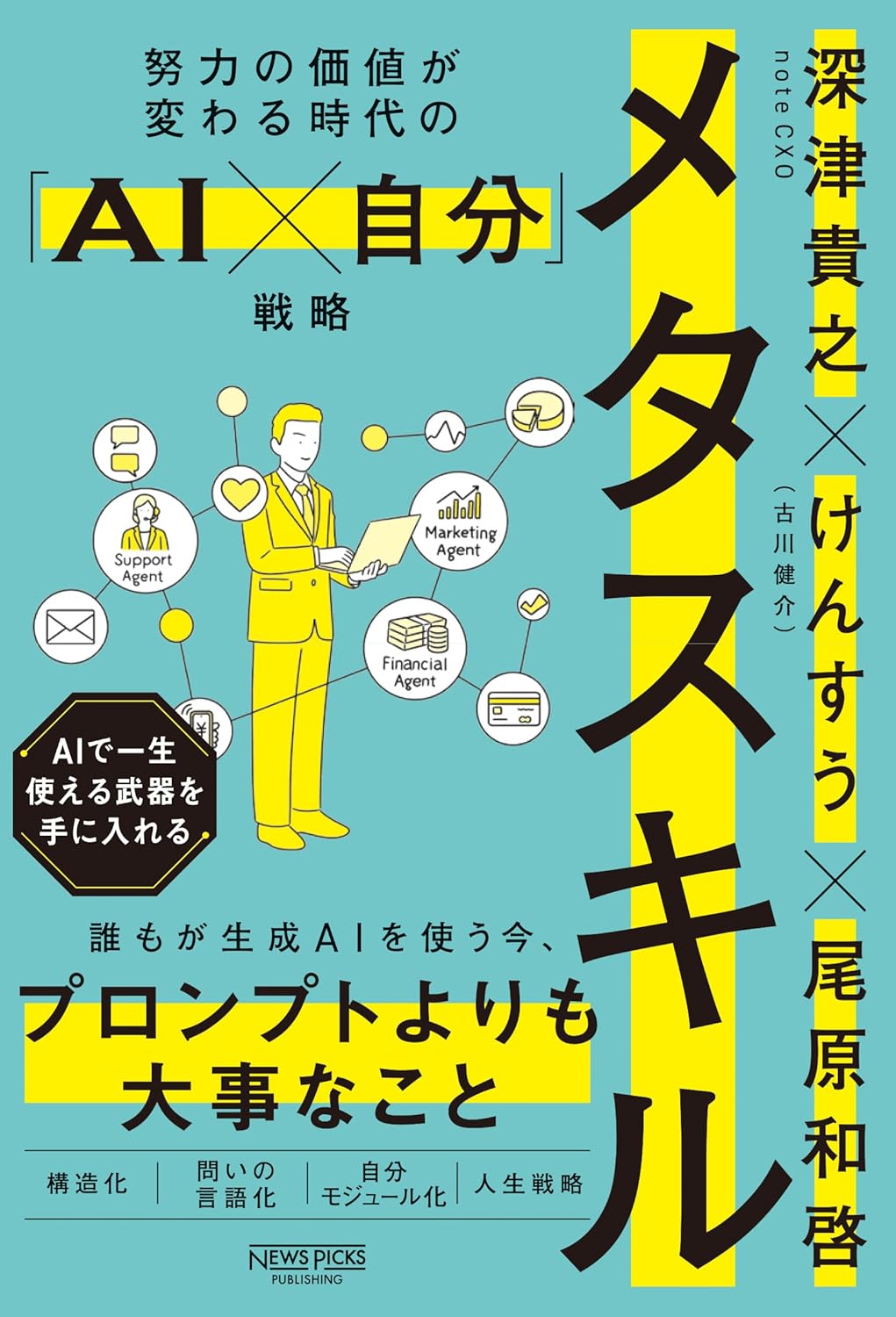 メタスキル 努力の価値が変わる時代の「AI×自分」戦略
深津貴之 尾原和啓 けんすう
メタスキル 努力の価値が変わる時代の「AI×自分」戦略
深津貴之 尾原和啓 けんすう
 AIの時代に頭がよくなる人 悪くなる人
岡 瑞起
AIの時代に頭がよくなる人 悪くなる人
岡 瑞起
 If superintelligent AI is created, humanity will become extinct
エリーザー・ユドコウスキー、ネイト・ソアレス、櫻井祐子
If superintelligent AI is created, humanity will become extinct
エリーザー・ユドコウスキー、ネイト・ソアレス、櫻井祐子