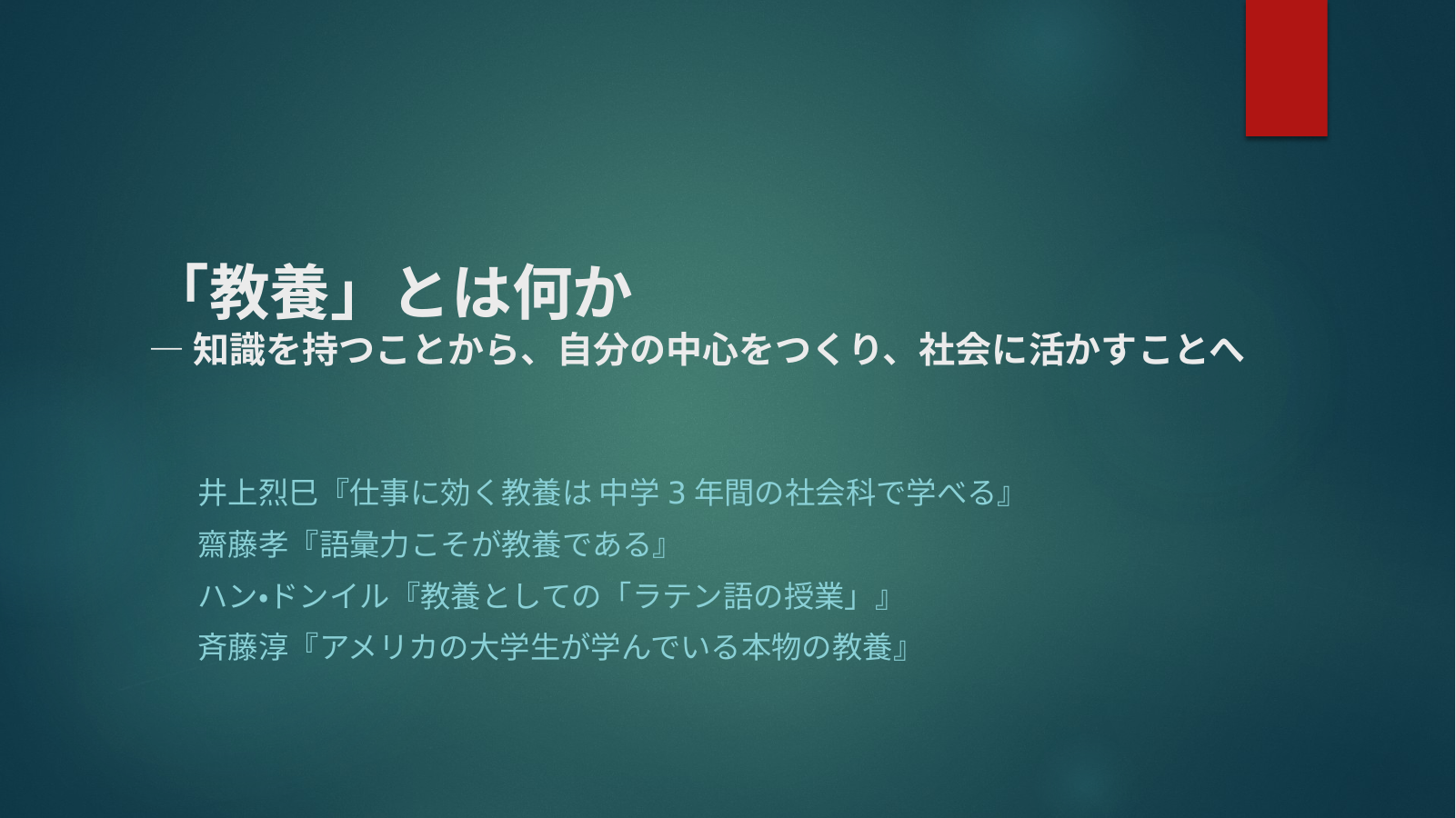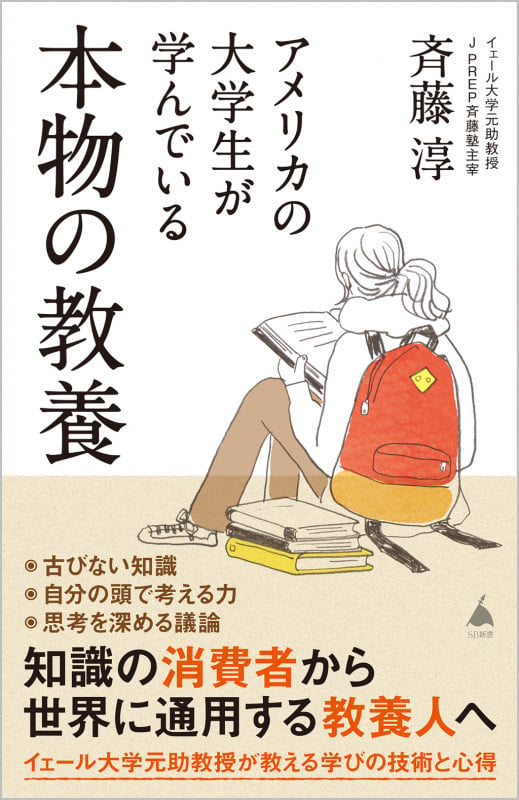
・Education is something that can be useful in various aspects of life as a result, but can be accumulated without setting a purpose, and the purpose of acquiring education is the process itself of acquiring education (p4) Education is essentially something that constitutes “the center of oneself” = nutrition that forms a philosophy of life and values one wants to protect. People who have formed such a “center of self” in the process of acquiring education are thoughtful, have dignity, and can also have respect and imagination for others (p9)
・In order to participate in Greek politics, an appropriately wide range of knowledge was necessary, so what was made “basic disciplines that people should learn” were the 7 subjects of “grammar, logic, rhetoric, arithmetic, geometry, music, and astronomy.” By acquiring these disciplines, citizens can go from being servile beings who follow the decisions of some privileged classes to “free citizens” who think for themselves and participate in politics of their own free will. It was called the “Seven Liberal Arts” for that reason, and this is the beginning of “liberal arts” (p5)
・The more you learn, the more your eyes open up to the world and your life options increase, and you acquire the intellect and ability to simply reach out to the vast world and achieve great success, but at the same time, this also has the potential to become increasingly detached and lonely from the values you are accustomed to from the community where you were born and raised (p15)
・If a tool called language is used, brain memory required for information processing, memory, and communication is overwhelmingly small, and since brain capacity is determined not by high intelligence but by how much memory is consumed, it is thought that Homo sapiens are less likely to use the brain by acquiring language, and their brains have become smaller (p38)
・Since memory devices are currently being developed, there is almost no value in just being “knowledgeable.” What is far more important than having knowledge is “what to think, discuss, and act with others using that knowledge” (p39)
・What I definitely want to do during the week to further improve the accuracy of my thoughts is to “take notes,” leave traces of what you have read and thought in some form, and even present consolidated sentences as training to convey your thoughts to other companies (p83)
・Being aware that we tend to focus only on visible data, and seeing things with the idea of being aware of the existence of things we can't see, and looking at things, this kind of daily activity “enhances education” as described in this book (p90)
・If you see an academic subject you want to learn, I recommend that you focus on reading the book. Read a lot of books in one field, and it is recommended to buy and collect about 10 remarkable books and make a plan to read them; in that case, it is a good idea to choose 2 books, an introductory book and a specialized book that seems interesting (p114)
・Books that have not been quoted at all from works written by others in the past cannot be trusted, and since there is a high possibility that such books were written only by the author's dogma and prejudice, they are basically “unnecessary to read” (p118)
・When you become an adult, the most important thing is “how do you think” based on facts; fact-checking is the minimum preparation required to create an original report, and it's just a foundation for thinking about things (p150)
・There are two things I recommend as training to create one's own opinions: 1) try to give reasons to both what you think is correct and 2) gather the main arguments from a reliable speech space when thinking about social issues (p155)
・In order to answer the “why” question, it is necessary to give an overview of various facts, add considerations in your own way, formulate hypotheses, and verify them using knowledge and information. In other words, it is not simply fact-checking in response to a question; it is an answer with a technical evaluation (= how do you evaluate a certain fact), and it is nothing but a trial process of forming one opinion (p158)
・What I want to aim for is to be able to think and form opinions with one's own head, but don't stop there and think “how important is this opinion socially, and what meaning does it have,” which “leads to suggestions that can be generalized.” It is only when there is a habit of sublimating opinions to such an extent that it is possible to live while being involved in building a better society as an educated person (p178)
・A skill that goes back and forth between “concrete” and “abstraction” is a skill that abstracts individual specific stories and sublimates them so that they can be applied more generally and universally. The beginning of the conversation may be a specific story, but in the end, it will be a story about “in other words, this is what this story is important to everyone” (p192)
・The point of going back and forth between concreteness and abstraction is to remove “individuality such as proper nouns” from what you originally thought and try to formulate hypotheses with analogies (analogies) (p194)