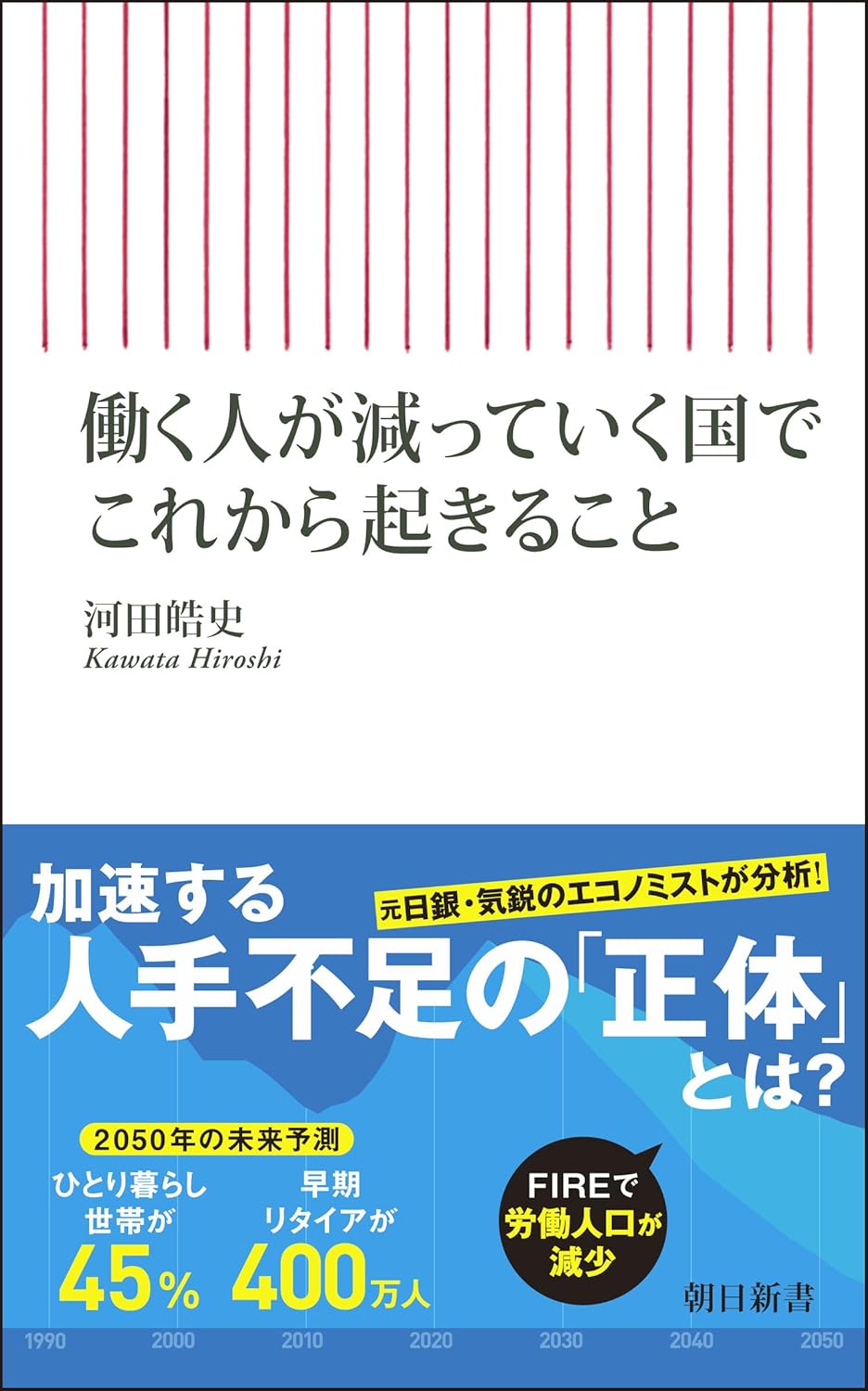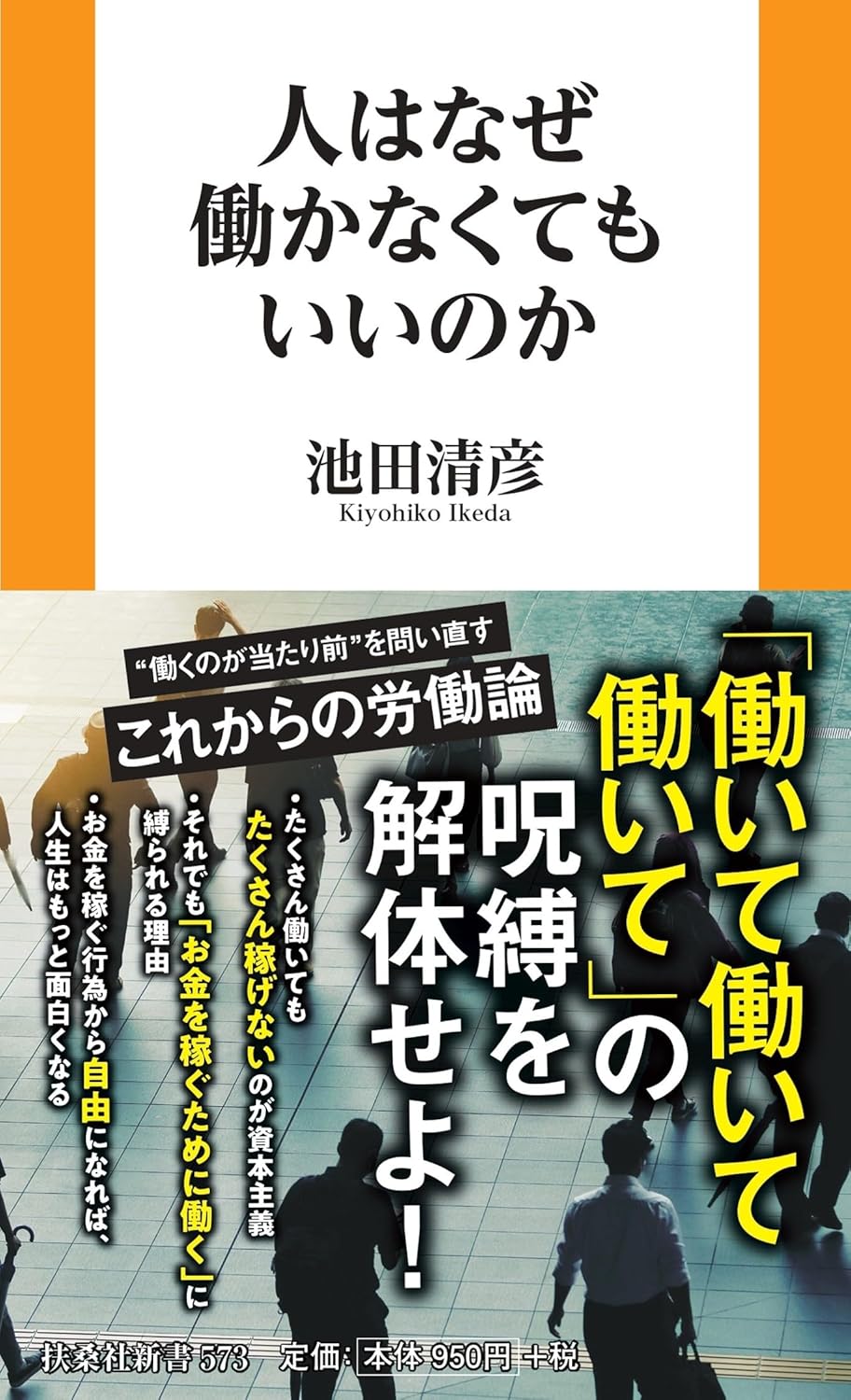
I was looking at the new publication on the internet, but I was shocked when I saw the title (why do people not have to work) and bought it on impulse. After it arrived, I read it all the way to the end, aside from the book I was about to read. Prime Minister Takaichi thought “work and work” was amazing, and I was able to learn the background and way of thinking explaining that “you don't have to work.”
I think “basic income” and “the limits of capitalism,” which I had only heard words, were also connected within me. I felt that now might be a time for an era to change.
Below are the points I was concerned about.
・Hunting and gathering are limited to the extent necessary for that group to survive; in other words, they live while putting brakes on in order to maintain the sustainability of the environment in which they live. Under such circumstances, those who work too much are a hindrance to the group, and not working too much is not because they are lazy, but because “not working too much” is important for survival (p32)
・Liver cells also have genes for making eyes, skin, and other organs, but only the genes that make the liver work. Other genes don't work just because they are there, and the liver is kept healthy only because other genes don't work (p35)
・I think that the reason homo sapiens are now able to communicate is that the system that moves genes has changed drastically without changing genes, and major structural changes have occurred in the brain even though they are almost the same genes. Major structural changes are probably due to changes in the system that controls gene expression rather than gene mutations (p40)
・What is thought to have become a major turning point in population growth was the ability to draw “things that don't exist in reality” in my head, probably at the center of this dramatic change called the cognitive revolution, which is the “cognitive revolution,” which is said to have occurred 70,000 to 30,000 years ago, and furthermore, it was the ability to share it with others. It is now possible for humans to believe in beings that are not right in front of them and talk about events that haven't even happened. As a result, notions such as spirits and gods are born, and myths and religions are shaped (p42)
・ Until 10,000 years ago, humans who lived in almost every part of the world hunted down large animals living on that land one after another, and there were several types of mammoths, but most of them disappeared around 10,000 years ago (p45)
・The Jomon settlement at Sannai-Maruyama seems to have continued for about 1700 years, but as a result, it collapsed. Harvesting in the country, which was probably the main force, became unstable due to the cooling climate, and settlements with a scale of 500 people could no longer be maintained. There is a high possibility that people searched for suitable places to live in small groups and returned to a more “small” lifestyle (p50)
・Rather than starting with humans becoming smarter, there is a high possibility that farming began because they were in a situation where they could not live without it; in other words, the fact that farming did not start in Australia may mean that they were able to live enough in a hunting and gathering lifestyle on that land (p51)
・Whereas dogs are relatively obedient and sensitive to human instructions, the fact that cats are somewhat capricious and “tsundere” is related to their origin; since dogs are descendants of Thai wolves, they live in groups and inherit the nature of following leaders, but cats are descendants of Libyan wildcats and live alone (p57)
・Japan changed from “tax payment with nengo rice” to “tax payment in currency” due to the land tax reform in 1873 (Meiji 6), and citizens were required to pay tax with money instead of rice from this time on, and due to this change in tax payment methods, the premise that humans “work for” was decisively changed (p65)
・The purpose of capitalism is set to “acquire profit and maximize it” rather than production itself. There is more value in how much profit you have earned and how much you have maximized it rather than what you have provided (p78)
・Economic growth is not simply a matter of effort, and the assumption that the number of people who make and buy will naturally continue to increase in Japan, which is influenced by how many untapped markets remain, is now a thing of the past (p82)
・If the evaluation axis for management is stock price rather than sales, it is natural that increasing shareholder value through share buybacks or increases in dividends is prioritized rather than expanding the market by turning profits into capital investment or wages. If you think about it in that logic, it is more reasonable to take a policy of reserving it within the company or managing it as a financial asset (p85)
・In the first place, there is a contradiction in the term “sustainable development” itself; “sustainable” means balance or maintenance, but “development” means expansion or expansion. Achieving sustainability within the framework of an expanded economy that assumes growth is almost impossible (p90)
・The reason people don't stop working a lot even when they know they won't be fully rewarded is not simply a matter of economic structure, but may also be because they are strongly bound by values internalized over a long history (p96)
・In the past, workers and buyers belonged to different classes, and in such a society, reducing labor costs must have worked only to increase profits; however, in today's capitalist society, this is not the case, because workers are consumers at the same time. When workers become unnecessary due to AI, unemployed people will overflow all over the country, and the ability to buy products will be lost. While product supply capacity increases, demand shrinks. No matter how large and how cheap it can be produced, a situation arises where no one can change it. This is fatal to capitalism, because capitalism is not a system of “making things,” but rather a system of “making profit by selling what you make.” If things don't sell, of course, there will be no profit, so neither expansion nor reinvestment will be established. In other words, if money doesn't circulate, capitalism will go bankrupt (p98)
・In order to maintain capitalism, it is more reasonable to think about a “system where minimum purchasing power is maintained even without working,” and introducing a system where “money can be obtained without working” in order to maintain capitalism that has driven people by “working to earn money” is an ironic story, but this can be seen as the construction of a new system to be applied to the new production structure brought about by AI (p99 )
・It is easy to think that basic income is a system of relief for the weak, but in fact, it is a system that is reasonable enough for both those who lost their jobs within the framework of capitalism and those seeking profit. If AI progresses steadily and the labor force becomes unnecessary and the number of unemployed people increases, and purchasing power drastically decreases, it seems that a future where basic income must be introduced will surely come (p102)
・ When 1% inflation occurs, the value of money falls by 1%, and those who had 100 million yen lost 10 million yen; on the other hand, if they had 3 million yen, purchasing power was 2.97 million yen, which is just a loss of 30,000 yen, and when 500,000 yen is paid there as basic income, they have a total purchasing power of 3.47 million yen, and losses due to inflation caused by basic income are compensated by basic income. A person who had 100 million yen would have purchasing power of 99.5 million yen even if 500,000 yen was added, which would be negative for 500,000 yen (p106)
・If basic income is introduced, there is no point if the money distributed is not used in the market, and if it is stored up, invested in stocks, or used to repay debts, the economy will not revolve. Therefore, it is important to establish conditions such as turning 70% of houses paid with basic income into consumption (p106)
・Ultimately, the economy moves in a relationship between “how much goods and services can be created = supply” and “power to buy it = demand” (p116) Inflation occurs when demand exceeds supply capacity, and deflation occurs when supply is too high in relation to demand (p117)
・Sri Lanka's financial bankruptcy is due to 1) it had foreign currency debt, and 2) it issued a currency that greatly exceeded productivity and was unable to control inflation (p123)