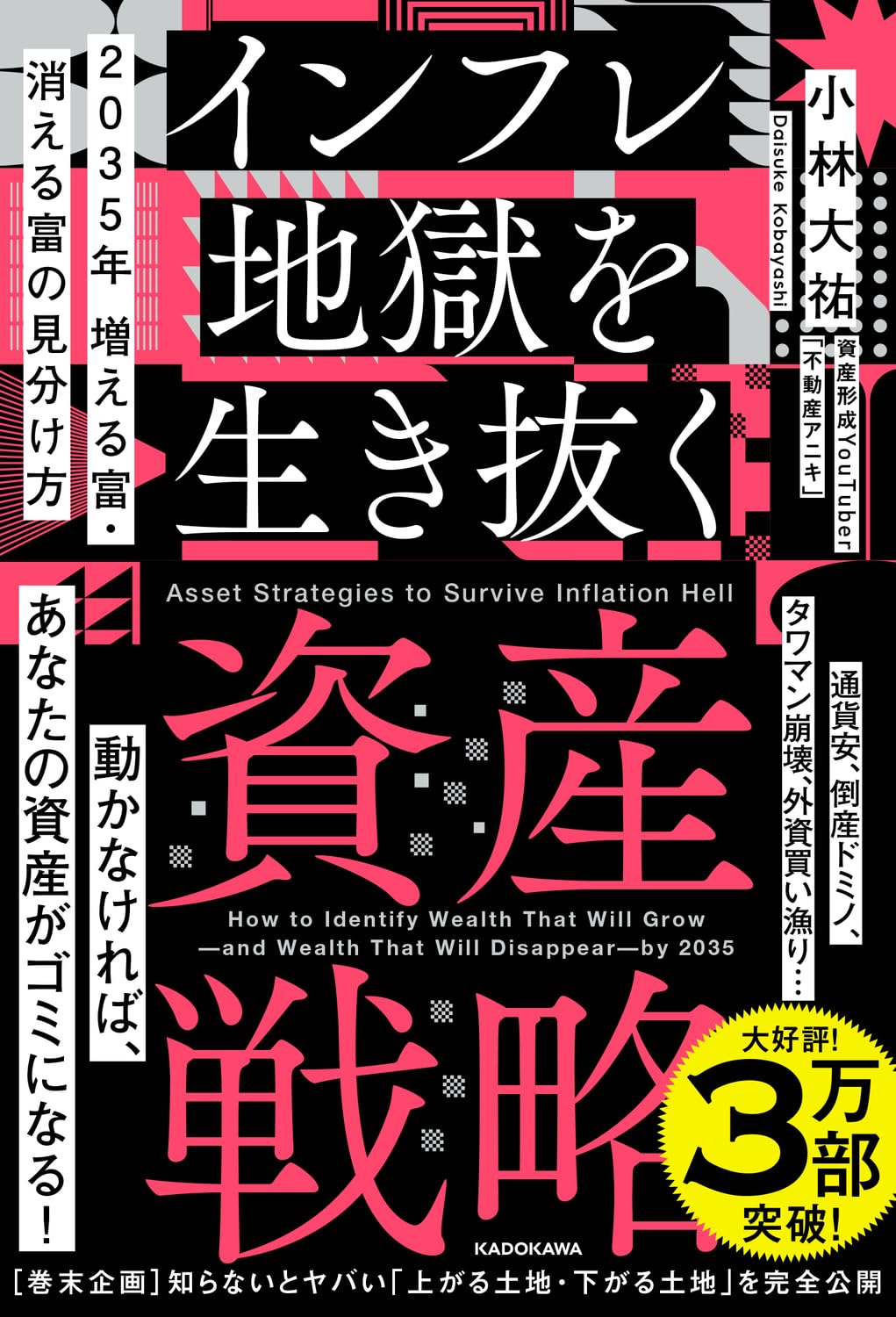
This book presents standards for determining “which assets will remain and which will disappear” in an age where inflation and structural changes are progressing. The author first points out that preparation for change is slow after having assets, and that crises take away from “those who have nothing” rather than “the poor” (p6).
Current inflation is not simply a financial factor; it is a cost push type involving a shortage of supply, and it cannot be solved by monetary policy alone (p27). This is because the supply of energy and supplies has been restricted due to Russia's invasion of Ukraine and supply chain disruptions, and what is required is a recovery in productivity (p27). In this situation, it is shown that there is a possibility that a “great reset,” where the value of the currency itself fluctuates, will arrive (p35).
The political and economic structure is also changing. In America, trade policy and security policy are integrated by tariffs, and the economy is driven as a national strategy (p42). Also, wage increases are the only solution to stagflation, but since companies that can implement them are limited, the gap is widening (p47). Therefore, it is necessary for individuals to enhance their own abilities, diversify their income sources, or find a way out in overseas markets (p49).
What is important in asset selection is to select “something that does not damage value.” The wealthy continue to choose assets that are scarce, supply is controlled, and market prices are maintained (p54). Instead of aiming for price increases, the idea is to own something that does not decrease in value.
Regarding real estate, the low interest rate environment and system peculiar to Japan are working advantageously (p59). The basis of asset formation is to “acquire a property whose value does not decrease with another person's capital and repay it with rent” (p108). However, for success, it is important to invest in urban areas rather than rural areas, and it is necessary to make money for that first (p114).
Entering a population growth market is an important condition when considering the future of companies and the economy (p63). Also, the trickle down is limited to central Tokyo and the surrounding area, and spread to rural areas cannot be expected (p68).
The current state of the Japanese economy is polarization progressing between some companies benefiting from the depreciation of the yen and many small and medium-sized enterprises (p185). There are many companies that cannot transfer cost increases to prices, and it is difficult to raise interest rates (p185).
Among assets, gold occupies an important position. The rise in gold prices is due not only to supply and demand, but also to geopolitical risks, central bank movements, and changes in asset allocation for the wealthy, and upward pressure is strong (p189). There is a possibility that the upward trend will continue cyclically from 2027 to 2028, and the possibility of reaching 10,000 dollars is also shown (p190). Also, due to the expansion of the gold-silver ratio, it is said that there is plenty of room for silver to rise (p191).
Furthermore, on the technical side, due to the spread of generative AI, the difference between those who use it and those who don't use it has widened, and the value of labor itself is changing (p204). Among them, the author recommends gradual growth by refining skills as workers, commercializing them, and investing with surplus funds (p271).
Also, in asset formation, an invisible asset called “credit” is important. Expenses involving credit create further opportunities and assets, but unreliable spending is simply waste (p290).
Ultimately, the author assumes that assets will be strictly selected in the Great Reset. What is rising is urban centers, highly liquid assets, gold, foreign currency, and technology, and what is falling is depopulated areas and assets with low liquidity (p319). The criteria for judgment are “whether the nation protects it” and “whether it can be immediately redeemed,” and only those who have this point of view can survive the next era.
summary
How to tell the difference between wealth that will grow and disappear in 2035 asset strategies to survive inflation hell