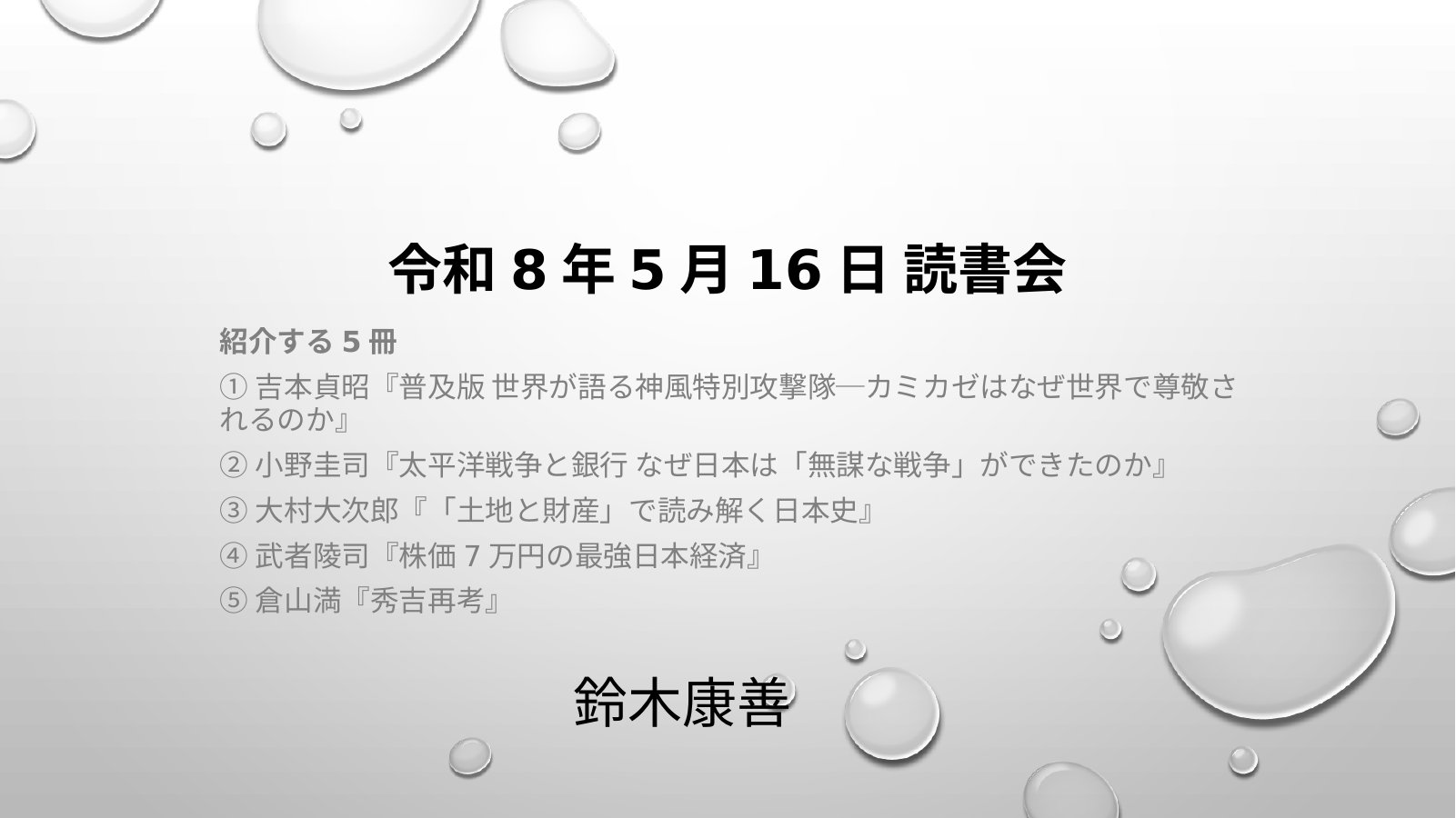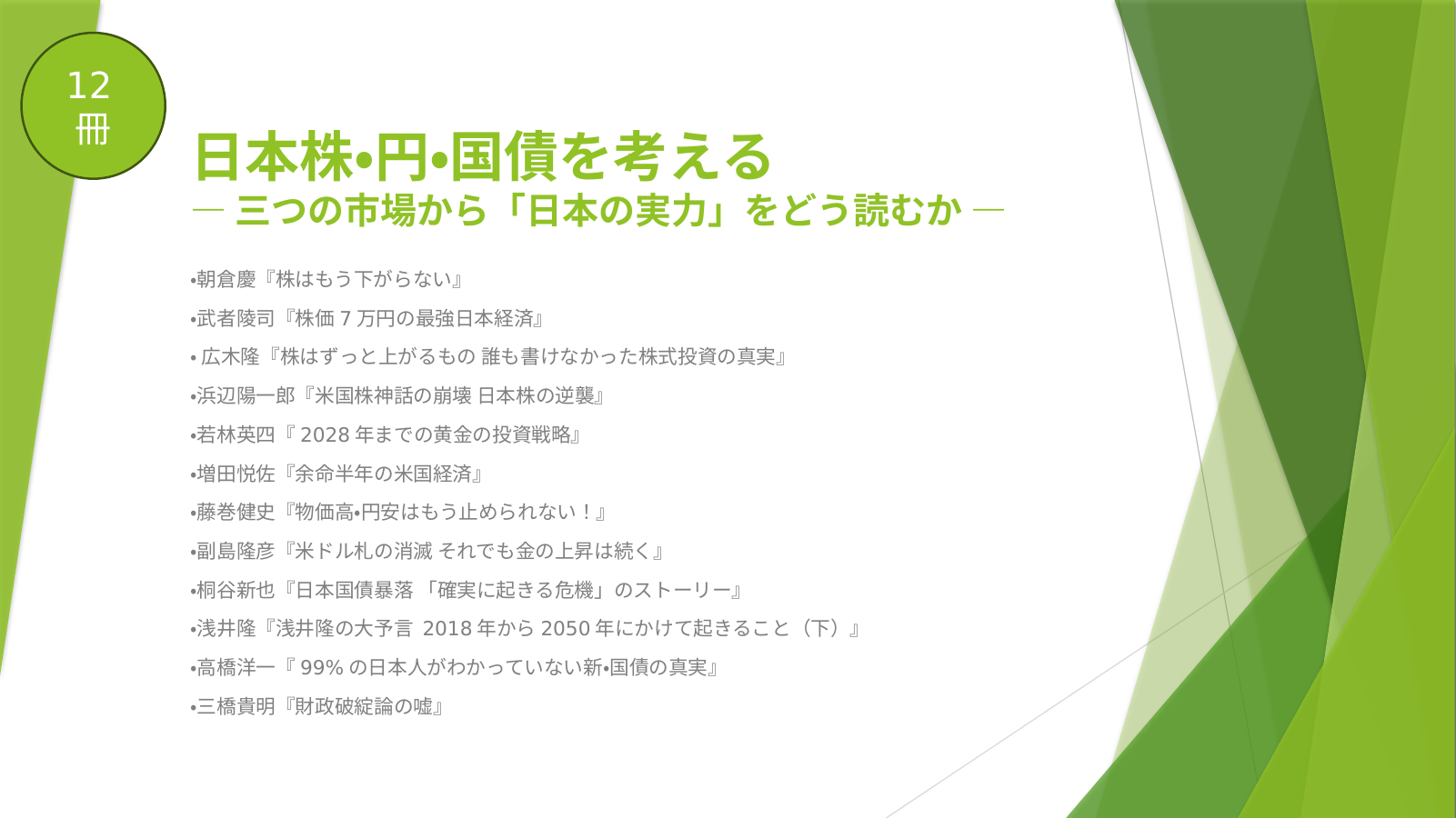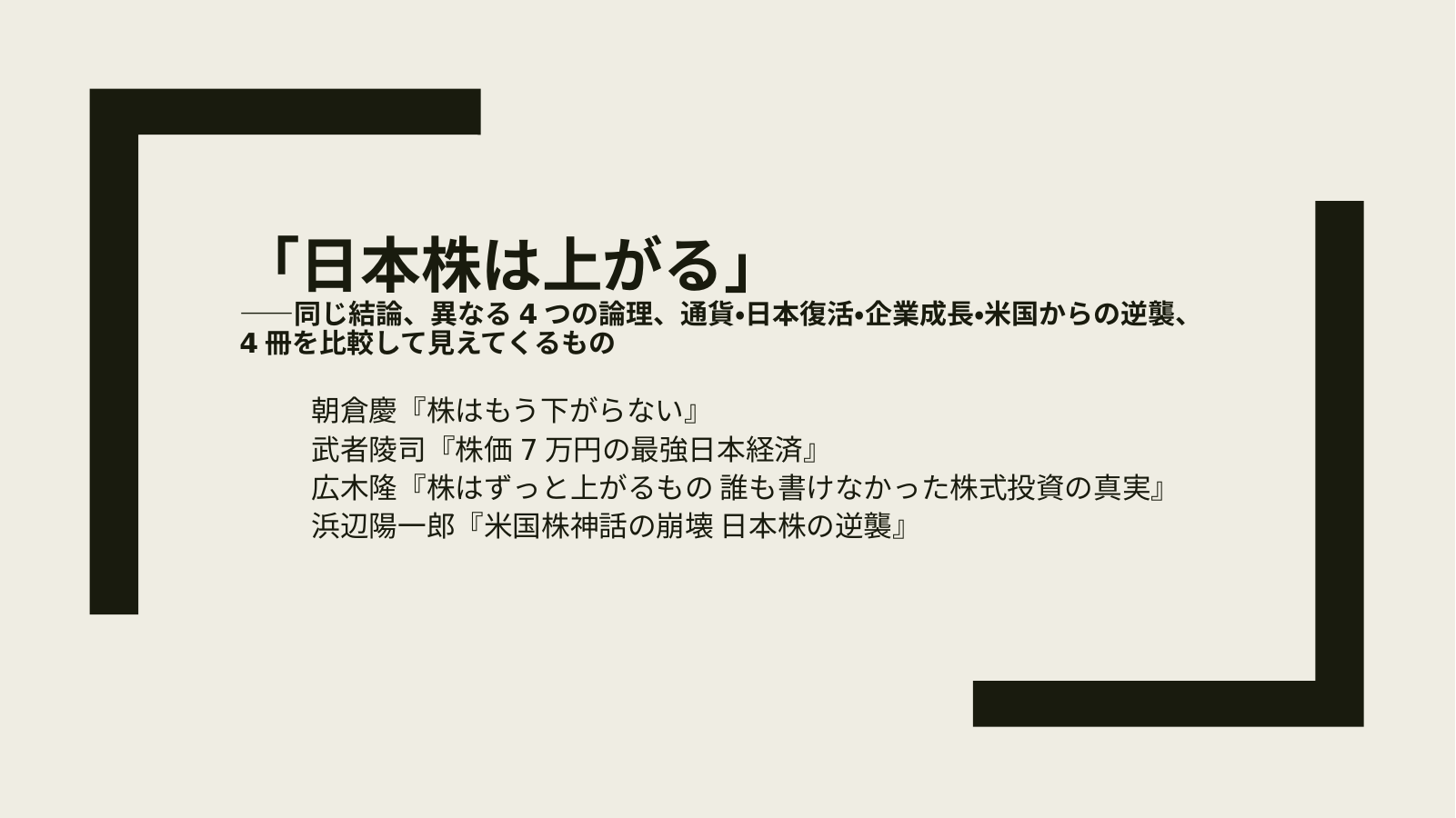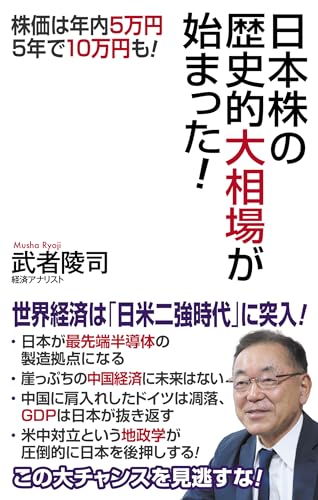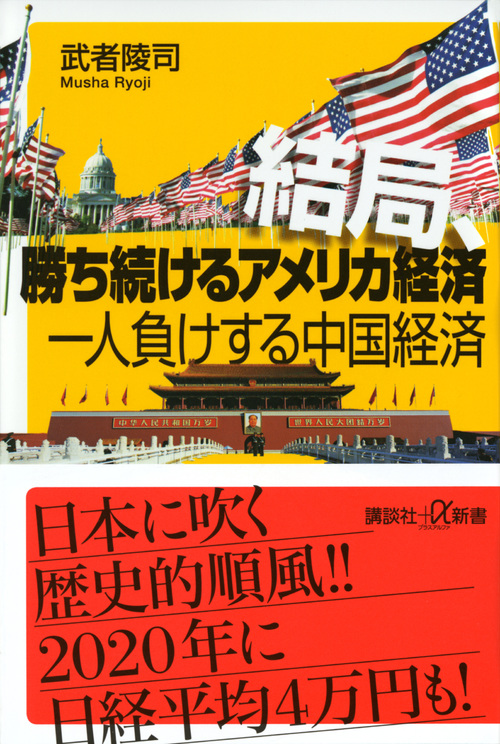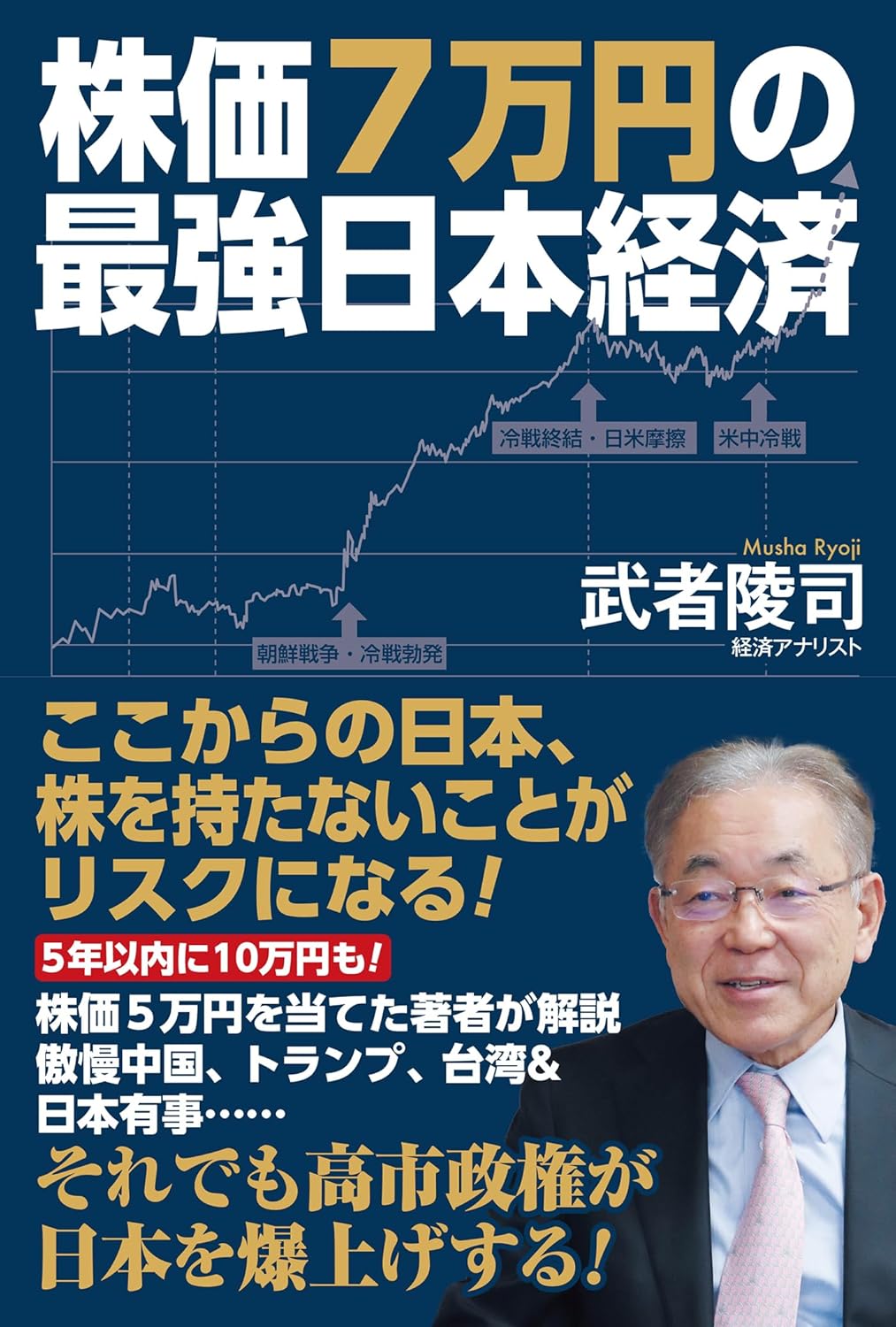
It is also co-authored, but this is the 5th book by Mr. Musha, the author of this book. Nikkei stock prices are high after the House of Representatives election is over, and I had read a book about stock prices crashing before, so at the beginning I couldn't believe that stocks would continue to rise, but considering that the value of the currency was falling, I thought stock prices would rise relatively.
In this book, it is pointed out that IT-related companies that are driving the rise in US stock prices have almost returned profits obtained through capital investment and dividends, so stock prices have risen, and I want Japanese companies that have accumulated internal reserves to take an example. In the future, it is likely that companies that have the power to export to overseas markets will further increase their stock prices, and I understood that if those companies increase stock dividends and capital investments, it is possible to reach “70,000 yen” within a few years, as the title of this book says.
Individual stocks are difficult, so I intend to hold them in a fund, but I felt that incorporating a fixed ratio of “stocks” into assets is necessary for asset preservation and management.
Below are the points I was concerned about.
・Mr. Trump succumbed to the threat of stopping the supply of rare earths, a material essential for the production of high-tech products where China holds 90% of the global market share, and shelved almost all trade sanctions against China, and if high-tech production stops, America will recede in 2026, and victory in the midterm elections will be uncertain. Before China's industrial power, Mr. Trump had no choice but a humiliating policy change (P3)
・Japan has two elements not found in the US, Europe, and China that lead the conservative-nationalist revolution to success: 1) economic testing and investment power: high corporate profitability, abundant savings capital, and actually rich fiscal capacity; 2) national cohesion: homogenous national character, restoration of prohibited nationalism (restoration of patriotism and nationalism) (P8)
・What makes me different from others is that I continued the work of discovering and thinking about economic predictions and making new hypotheses from there (P21)
・What is behind the depreciation of the yen, it is because America sought a strong Japan due to the worsening US-China confrontation, and this is all; many economists look for the cause in “interest rate differences,” but that alone is impossible for such a revolutionary change in exchange rate levels to occur and become established (P25)
・From 1969 to around 2012, America forcibly led to an appreciation of the yen in order to take away Japan's power, and as a result, the yen dollar rate increased and the domestic and foreign price difference hit Japan's exports, but from 2015 it transitioned to an era of depreciation of the yen, and as of 2023, the purchasing power parity was 94.6, the exchange rate was 151.1, and such a large “reverse internal and external price difference” supported the Japanese economy (P32)
・There are two international prices; one is domestic price, which is determined for reasons specific to each country regardless of the exchange rate; it is “labor costs and rent,” and the second is an international price and is a transaction between countries; the second is an international price and is a transaction between countries; the cheaper the exchange rate, the higher it is in Japanese yen (P35)
・Items that are inflated in America and deflated in Japan are those related to domestic prices, and foodstuffs, housing, medical care, education, education, education, entertainment, and services are all items where labor costs and rents are greatly affected, and in America, these increases are boosting prices and causing inflation. In the case of Japan, far from being low, the rate of increase in labor costs is low, they wait for service competition and are sluggish, so they are showing a reflex (P36)
・China cannot switch to a consumption-driven economic model like developed countries, reasons: 1) the collapse of China's bubble is still at the entrance and there is no exit at all, 2) financial burdens are necessary for bad debt processing and consumption leverage, but cannot be absorbed by the current Chinese economy, 3) an increase in disposable income cannot be expected due to deterioration in corporate profits and employment and falling wages, so in that case the only answer is “increase in foreign investment” (P49)
・President Trump finally acknowledged “G2,” that is, China as one of the two largest countries in the world, and it should be impossible for America, which is the sending country, to recognize China as a hegemonic country of the same rank, but this is a very symbolic change (P57)
・Prices in America have now settled at around 3%, and it's been 8 months since tariffs were raised, but they haven't risen that much. The reason for this is that internationally traded manufacturing products account for only 19% of the CPI (Consumer Price Index) (P68)
・The balance of the US budget has been increasing since around 2021/5, and what supports this consumption is not only salary but also “asset income = interest dividend income/rental income,” and the other is “government support” (P80)
・The United States enacted the “Genius Act” and made it clear that virtual currency will be introduced in earnest in the United States, implementation is 2027 or later, and the outline is “issuing a virtual currency called table coin.” Institutions that issue stablecoins in return are conditional on securing American government bonds or safe and secure assets comparable to them, and it is not the American central bank that issues them, but the government It is a private commercial financial institution approved by (P95)
・The dollar is the only key currency in the world, and Trump's aim is to greatly reinforce the dollar standard system by introducing a virtual currency called stablecoin (P99)
・There were two major bubbles in modern America: 1) the abolition of the gold standard system in 1933, which is an obvious bubble that made money free; 2) it is an abandonment of computational equilibrium due to the introduction of the Keynes policy, where people accumulate debts using more and more money than tax revenue without worrying about budget deficits, and table coins become a “demand creation” machine as soon as the abolition of the gold standard system and the abandonment of fiscal equilibrium This is a historic change (P105)
・The current AI boom is an industrial revolution far more powerful than the internet in the past, and the biggest difference from the time of the internet is “dream or reality.” At the time, I invested in the dream of the internet, but now it's not a dream, the market price is buying reality, and the current state is that they are investing while profits are coming (P120)
・The virtuous cycle of not only investing ahead, but investing profitably, and making sufficient shareholder returns, has continued for 10 years (p122) 90% of net profit is applied to dividends and company stock buybacks (p127)
・Magnificent Seven (GAFAM+NVIDA, Tesla) invests in equipment and buys things from NVIDA at a very high cost, invests in this expensive profit since NVIDA's profit margin is extremely high, and creates a data center with money set by oneself, receives orders from that data center, and sells things, it seems that there is a business flow like a circular cycle, “investment generates investment, so to speak There are people who argue that “they may be creating an imaginary cash flow that doesn't exist,” but it's clear that it's not irregular and that it's not to inflate profits through accounting processing; it's actually investing and operating equipment to make money; if you think about it this way, this is not a circular investment (p135)
・Even though China's purchasing power parity is 1 dollar = 4 yuan, it is actually 7.1 yuan, and when the world market share is calculated, the global manufacturing production share goes from 32% to 40% or more, and this number was not outside of America immediately after World War II. This happened after 2018, when Trump began a fight with China, and it can be seen that America's sanctions against China were not heard at all . The main reason for this is that the coronavirus has benefited China. Only China locked down Wuhan to prevent the spread of the infection to other regions and put factories into operation. As a result, the Chinese manufacturing industry took the world by storm (p143)
・High government administration is about to carry out a conservative revolution, and it has taken a major turn from the liberal middle road line of the Self-Government Coalition up until now to the pivot of constitutional reform, voluntary defense, and active finance in the Liberal Democratic Restoration Coalition (p179)
・Until now, I thought the Nikkei Average would be 100,000 yen in 10 years, but in a few years it went from 60,000 to 70,000 yen, and I changed my mind that 100,000 yen could be possible in 5 years (p231)
・If you have enough money to spare now, you should prepare for future stock surges; individual stocks are difficult, so index investments are recommended. The reason for this is that the most important economic structure in the world is “stock capitalism,” and capitalism revolves around having a stock market at the foundation of the economy, and without stock-centered asset management in this era, it is a huge loss in asset management (p245)