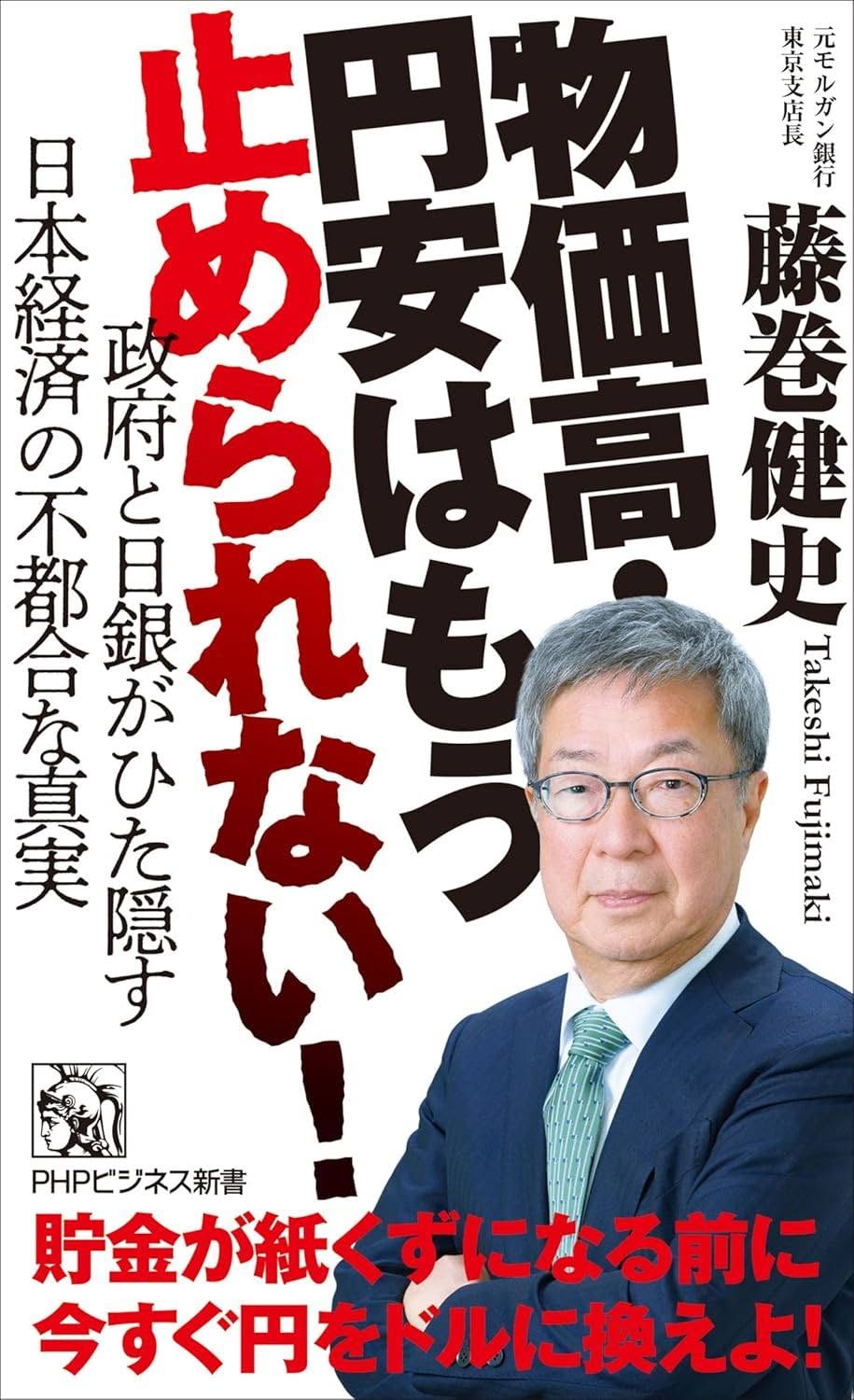
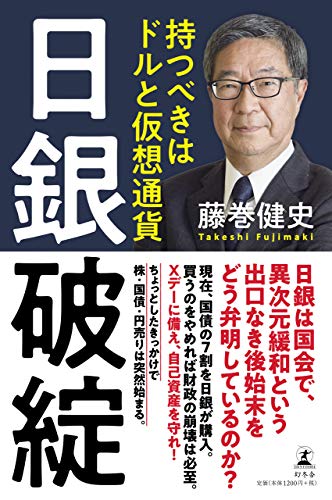
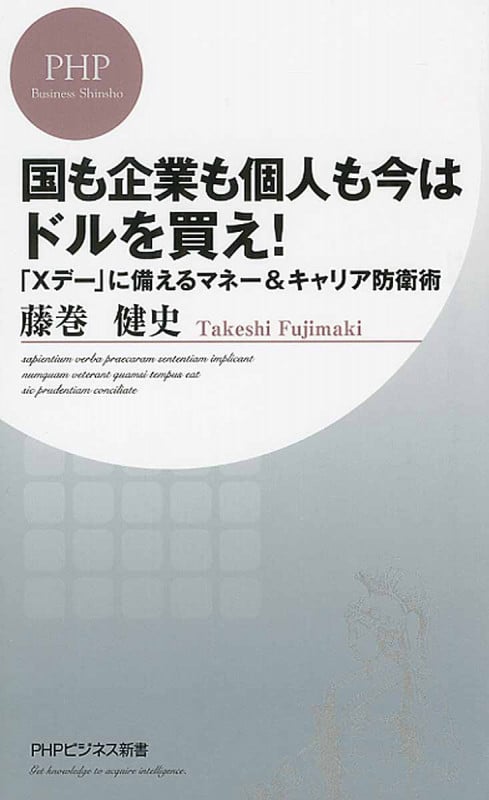
“The high prices and depreciation of the yen are unstoppable! In “The Inconvenient Truth About the Japanese Economy Hiding by the Government and the Bank of Japan,” Mr. Takeshi Fujimaki warns that the Japanese economy has already surpassed the stage of a “normal fiscal nation,” and that it is in a dangerous state where life has barely been extended due to cross-dimensional monetary easing by the Bank of Japan. The central theme of this book is that “the depreciation of the yen and inflation are structurally unstoppable, and there is a high possibility that they will eventually lead to a currency crisis.”
The author first explains that the current rise in prices is not temporary, but structural. Reasons for this include ① that the Bank of Japan has not been able to raise interest rates sufficiently, and that real interest rates remain drastically negative, ② asset prices such as stocks and real estate have risen, and asset effects are accelerating inflation (P7). In particular, currently, unlike the bubble period, there is no deflationary factor called an “appreciation of the yen,” so it is assumed that there is no mechanism to counteract inflationary pressure (P9).
The author sees the current state of Japanese finance as extremely dangerous. The current Japanese government debt has reached about 1342 trillion yen, but even so, it is said that the reason why financial bankruptcy has not occurred is that the Bank of Japan continues to buy government bonds in large quantities due to the prohibition called “cross-dimensional monetary easing” (P43, P53). Originally, if the issuance of government bonds increases, interest rates will rise, and finances will become unsustainable. However, since the Bank of Japan bombarded government bonds in the market, it is analyzed that interest rate increases have been suppressed (P67).
The problem, however, is its side effects. The Bank of Japan has a large amount of long-term government bonds, and it has huge valuation losses due to rising interest rates (P91). Furthermore, it is said that it is in a state where excess debt has barely been avoided due to stock assets such as ETFs. The author criticizes that financial institutions around the world evaluate even central bank opponents with market value accounting, yet only the Bank of Japan defers issues with book value accounting (P93).
Therefore, the Bank of Japan is unable to raise policy interest rates drastically. This is because if interest rates are raised, government bond prices will fall, and the Bank of Japan's losses will increase rapidly (P96). However, if interest rates are left unchanged, real interest rates will continue to be negative, and yen depreciation and inflation will progress (P107). In other words,
Bank of Japan crisis if interest rates are raised
If interest rates are not raised, yen depreciation and inflation will accelerate
Assume that it is in a “clogged” state called (P108).
What the author emphasizes in particular is the concept of “inflation tax.” The government cannot fill the budget deficit by raising taxes. In fact, only a small number of people pay high-rate income tax, and it is said that tax revenue increases are limited by the wealthy tax increase alone (P73). Therefore, it is argued that in the end, there is no choice but to lower the value of money due to inflation and substantially transfer national assets to government debt repayment (P76).
The author distinguishes between normal inflation and hyperinflation. Normal inflation occurs due to supply and demand, but it is said that hyperinflation is caused by “loss of credit to central banks” (P85). In other words, even if Japanese government bonds do not default, it warns that a yen crash and hyperinflation may occur if trust in the Bank of Japan itself is lost (P124).
In this regard, the author believes that the evaluation of CDS and rating agencies misunderstood the essence. What the market is looking at is “whether government bonds will be formally repaid,” and it is not whether “the value of yen itself” will be maintained (P124).
Also, emphasis is placed on the fact that Japan does not have “resources to support currency” such as Russian crude oil. Even under sanctions, Russia had the power to “only sell crude oil in rubles.” However, there is no such thing in Japan, so once yen is converted into local currency, recovery is difficult (P176).
Therefore, the author recommends the transition to foreign currency assets such as dollar-denominated MMF as an asset defense measure (P145). Also, since the payoff system does not guarantee “maintaining the value of yen,” it warns that it will not be sufficient defense during a financial crisis (P155).
Furthermore, the author believes that there is a problem with Japanese society itself. Japan was unable to grow while continuing fiscal transfers, but they argue that the reason for this is not “austerity,” and that it is a socialist structure where it is difficult to make a difference between working and not working (P165).
Finally, the author even mentions the possibility of “German-style currency reform” as the worst case. In other words, it is a scenario where the Bank of Japan is destroyed and a new central bank and a new currency are introduced (P199). In that case, the current yen will lose value, and national assets will be greatly damaged.
This book depicts the Japanese economy as “the world's worst level of fiscal and monetary dependency,” and the content warns extremely strongly about the possibility of yen depreciation, inflation, and currency crises.
summary
The high prices and depreciation of the yen are unstoppable! The inconvenient truth about the Japanese economy hidden by the government and the Bank of Japan