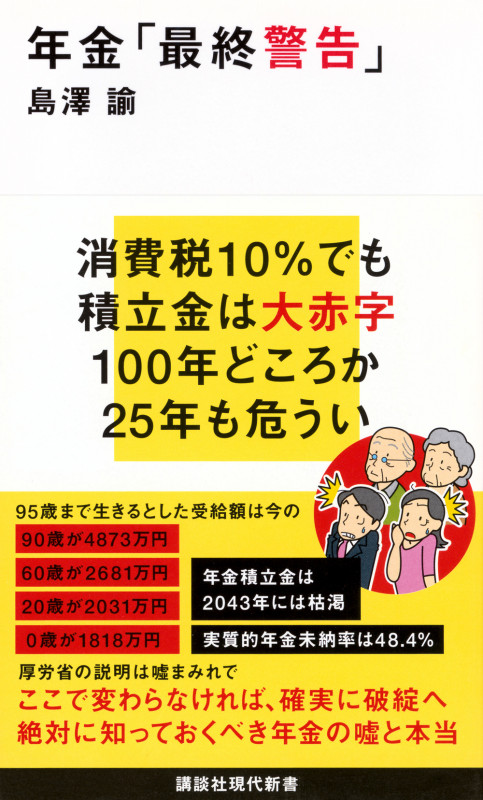
・Using data from the Ministry of Health, Labor, and Welfare to calculate the probability that a 12 year old (male and female) 20 year old, 30 year old, 40 year old, 50 year old, and 60 year old will live to 100 years old or older, it is only at least 6-20%. The “100-year age of life” advertised by the government is slightly large furoshiki (p15) The probability that a 65-year-old person will live a long time varies depending on the year they were born, but in 2029 (my case) men up to age 90 are 45%, 22% until age 95, and 6% until age 100 (p21) The “100 Year Life Era” is too exaggerated, but it can't be underestimated (p17)
・It is wise to make a financial plan for old age assuming that you will live until the age of 95, and if you take the annual consumption amount (270) x life extension (5 years) for the 80s, it is 1.35 million yen. Considering public pensions, 9 million yen more is needed (if you start receiving benefits at age 65 and die at age 95, you will be paid an average of 67 million yen, and living expenses during that time will be 76 million yen minus 9 million yen), in total, 900+1305 = 22.5 million yen will not be enough (p19)
・People who can live with only total income (income other than pensions, such as withdrawing pensions, etc.) are 45% with a total income of 300 to 4 million yen, but 83-96% if it is less than 1 million yen, and 51% (p22) of all 60-year-old households have savings of 20 million yen (p25)
・The pension system will collapse if there are no people who can bear it, so the “macroeconomic slide,” a mechanism for reducing pension amounts in response to the power of the active generation to support pension systems and the increase in the average life expectancy of Japanese people while looking at pension financial balance trends for the next 100 years, was first launched in 2015/4, and the second time is 2023 this year. The government says adjustments, but that means cuts. Future pension reductions are inevitable (p30), and there is also a “financial verification” that re-evaluates the pension finance situation once every 5 years, and although it has been performed 3 times until now, none of them have shown diagnostic results that large-scale surgery needs to be performed (p30) it is called a 100 year safety plan, but what is safe is the public pension system, not our pension amount (p32)
・The national pension and welfare pension were initially separate; the welfare pension was established before the war, and the national pension was established after the war. Since all citizens of Japan were covered by the public pension system due to the launch of the national pension, this was called the universal pension in 1961. (p35) Originating from “worker pension insurance,” which was launched for only male factory workers during the war in 1942, it was also applied to office workers and girls in 1944, and was renamed welfare pension insurance, so there is a reserve system and time lag from the start of collection to the start of payment in order to apply collected insurance premiums to war expenses (p65)
・The total number of pension insured persons is 6733 (1505,4358,870) million, and for No. 2 insured persons, defined contributions (648), defined benefits (901), welfare pension fund (57) = welfare pension insurance (3911) + retirement pension benefits = civil servants (447), and iDeco (individual defined contribution pension) is 850,000 (p37)
・Current public pensions are operated by a levy system, and since the active generation supports the elderly generation, the country reads it as “mutual aid between generations,” but the essence of this is the same as presiding over a pyramid scheme where the country is supposed to prohibit by law, and forces citizens to participate (p53)
・Since social security benefit expenses increase by 3.1 trillion yen every year, and social insurance premiums only increase by 1.7 trillion yen, the difference (1.5 trillion yen) increases due to taxes (and debt = government bonds), and insurance premiums and taxes cover the increase in benefits by almost half (p71)
・The number of elderly people (75 years and over) will peak in 2042 (30.35 million people) after that, the elderly population will decrease, but the population will also decrease, so the peak aging rate will be 35.58 million in 2067 (38.4%) 2018, 28.1% (p100)
・In the 2004 100-year safety plan ranking, it was raised 0.354% every year from 2005 and fixed at 18.3% in 2017, and the upper limit was revolutionary (p108). As of 2004, the income replacement rate was 59%, but it automatically dropped, and it became 50.2% in 2023, and the macroeconomic slide came to an end. After that, 50% was maintained, and security of pension finances until 2100 was guaranteed, pensions for the elderly were protected and the stability of pension finance was impaired, and the pension reduction period was postponed to 2043 (p111) reserve funds were exhausted in this year, not 100 years of peace of mind, and the safety of 25 years is also in jeopardy (p121)
・Actual social security expenses are 33.6% of social security-related expenses +one-third (5%) of local grant tax +60% (16.6%) of government bonds = 55.2%. Military spending just before the start of the Pacific War accounted for 50.3%, and now social security-related expenses account for 55.2%, and it is not an exaggeration to say that the country's finances are at war with social security (p128)
・There is a disparity of 120 million yen between the 0-year-old with the largest net burden and the 90-year-old with the largest net burden, and a disparity of about 50 million yen between the grandparent generation (60 years old) of 9.85 million yen, and the 0-year-old 58.34 million yen. Grandchildren lose 50 million yen more than their grandparents (p140)
・Since there is no net worth in public pensions, there is no choice but to raise insurance premiums, increase tax input, or reduce pension benefits (p149)
・Net pension debt has increased from 570 (2004) → 690 (2009) → 920 (2014) → 1100 (2019) because macroeconomic slides did not work (p159)
・The Scandinavian countries first prosper their economies with natural resources and military industries, and the reason why social security is strengthened with that money, and Japan was able to have everyone's pension and everyone's insurance is because there was a strong economy against the backdrop of high economic growth (p184)
Read 2023/9/25