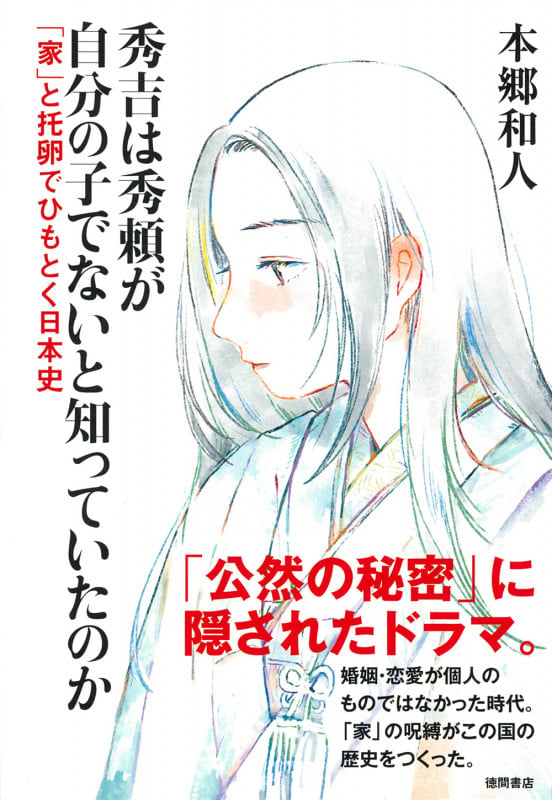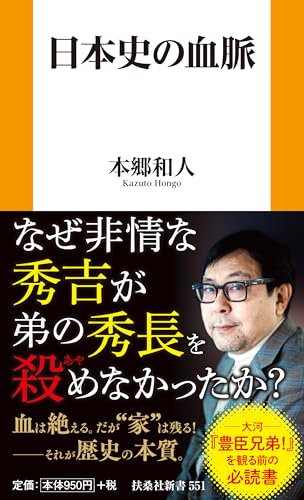
・Toyotomi Hidenaga was not just Hideyoshi's younger brother; he was an essential presence for stabilizing the administration, and he was an “asset” that the Toyotomi family should make use of. Conversely, it was not protection based on affection, and life and death were divided by calculation of power, which was the reality of the Sengoku period (p5)
・ “Blood line” and “home” were powerful forces that defined people's lives, and which family one was born into greatly influenced the future, and the presence or absence of a lineage determined the value of that person. That is why it sometimes gave rise to violent confrontations and purges between siblings. However, at the same time, it was also a system that supported national stability and social order. This structure remained strong even in modern times, and the Meiji government established a family system, ordered blood lines and family ranks, and incorporated them into the new national system. Also, the family register system made all citizens belong to a “house,” making it possible to control the unit by house (p7)
・A surname is equivalent to a current family name and is the name of a house, that is, a family name, and “clan” is often thought of as a surname, but historically it indicated an ancient ruling family or family and represented a blood relationship or political group. However, he later came to be used almost synonymously with “surname” (p27)
・After Nakatomi Kamatari's death, his child Fuhito also called himself “Fujiwara,” and at first, several people who were Kamatari's cousins also called themselves Fujiwara, but they soon returned to their original name due to circumstances where they could not afford to remove Nakatsumi, who had managed Shinto rituals in the Imperial Court from generation to generation. As a result, Fubito was the only person who continued to carry the name of the new Fujiwara (p29)
・As for the eight color surnames, there were Masato, Asami, Sukune (sukune), retainers, etc. in order from the top, but in the end, only the “Imperial Minister” stood out and remained. One reason is that many influential races were given the surname of the Imperial Court in return for their contributions to the Imperial Court (p32)
・There was too much “Fujiwara” in the Imperial Court in Genpei Tachibana, which meant that this was inconvenient, and it became necessary to call each house within the Fujiwara clan by name. This is the beginning of the current “surname” (p33)
・Fujiwara Michinaga is called “Michinaga” in “Fujiwara,” and “no” is often included in the name, but “no” disappeared in an age where people were called by their surname, and there were differences between the ages in whether he used his family name or surname (p34)
・Among the clans, people corresponding to the head family maintained ties with the Imperial Court and continued to call themselves “Taira/Gen,” which is their own clan, but families rooted in the region created family names bearing place names of their territories, such as “Hojo in Izu” and “Miura in Sagami.” Thus, a framework called the “house” of the samurai society based on family names linked to the territory was established (p36)
・is that person's real name, but originally, it is something that must not be said lightly in public, as if written as an “abomination name,” and it is not openly called by anyone as it is now. This is probably because at the time, names were thought to have spiritual power. It was considered a good idea for someone in a higher position to call a person in a position below oneself, but it was extremely disrespectful for a person or subordinate in the same position to call “.” Instead, what was used to call out was a “common name,” and common names were allowed to casually call someone superior even if they were in the same position or current person (p37)
・Taking her husband's last name may not have simply been an institutional change for women, and I think there are more than a few women who were relieved to finally be able to leave their parents' homes with this (p55)
・There are no adult men of suitable age to ascend the emperor in the imperial family, and it is possible that a time when the next candidate for the emperor was still young, and in that case, the mother or older sister of the boy who was a candidate for the emperor would ascend to the throne as an emperor. There is only one empress who broke that common sense, and that is Emperor Koken, the only daughter of her parents, Emperor Shomu and Komyo High School, and the only female person in history to ascend the throne after going through the “Crown Prince” (p61)
・In a nomadic society, livestock were distributed independently in order starting with the older children, so the last remaining youngest child built a house was born naturally (p71)
・Notwithstanding the same Taira clan, their “lord” didn't listen to their voices and didn't move, so the Taira clan worked hard to find representatives who could speak for them, and what they arrived at as a result was a leader named Minamoto Yoritomo, who has a venerable “clan” similar to the Taira clan (p77)
・As the Jisho-Juei War, which occurred from 1180 to 85, is called the “Battle of Genpei,” it is easy to think that the Minamoto clan and soldiers were in conflict in history, but this is different from reality. The actual composition is “the Taira clan (who was qualified to ascend to the Imperial Court) + the military aristocrat Taira vs. Minamoto no Yoritomo plus the local lord Taira clan whose status was superior” (p78)
・It is whispered that Hachinohe in Aomori prefecture, which is the base of the southern part, and the “Oura clan,” who was born in a family that follows the southern family and declared that he would become a daimyo around Hirosaki in Aomori prefecture, changed their names and Hirosaki, which is the base of “Tsugaru,” have always been on bad terms, and the grudge between the two continues now (p92)
・What is noteworthy is that the Hojo family thoroughly stopped at “fourth place” in the official position; if they climbed to the 3rd place or higher, they would stand shoulder to shoulder with the central aristocrats, but the Hojo family did not dare to step in there, and they chose to formally position “below the nobility” without going beyond the position of samurai (p117)
・If the house of a woman who married a seriously equivalent prestigious family falls, the position of the eldest son, who had been regarded as the heir until then, may fluctuate. When they are welcomed as the second son or third son's wife from a prestigious family that has gained new momentum, the child born to that woman is selected as the new heir. There is no way to simply throw out the eldest son who was removed from the heir, so it was the Kira family and the Imagawa family that divided their territory and property instead, and it was the Kira family and the Imagawa family that were established in this way against the Ashikaga family (p144)
・Ijuuin Tadazane, whose father was slaughtered, was furious and started a rebellion called the Shonai Rebellion in Miyagi prefecture, and this army was strong and the Shimazu family took a lot of time and effort to suppress it, and as a result, the Shimazu family was unable to send enough soldiers to the Battle of Sekigahara, and originally only around 2000 when they had the power to send out 10,000 or more soldiers (p159)
・Even during the Sengoku period, there aren't many of them, and as far as the author knows, the person who achieved the most successful surrender was Nabeshima Naoshige, who paid for the Hizen Saga Domain, and what Hideyoshi gave as necessary elements to take over the country was courage, wisdom, and atmosphere. The atmosphere is a healthy ambition. Hideyoshi assumed that there were 3 people who had 2 of the three elements, and even in the era of turmoil (p161) during Naoe Kanetsugu, Kobayakawa Takakage, and Nabeshima Naoshige (p161), “connecting all of the vassals and hereditary families” was prioritized over Shimokatsukami in Japan. The country called Japan was a society lacking in energy to achieve succession in the true sense of the word, and the power of hereditary succession was overwhelmingly large (p165)
・Genealogy trees are written vertically and horizontally, but older genealogy trees are written vertically (p180)
・Hidenaga was an extraordinary person, but above all else, he knew how to take a step back from his older brother, and it was because he had that attitude that he was utilized without buying missionaries from Hideyoshi (p200) The fact that he was valued rather than being an excellent person because Hideyoshi cherished him is proof that Hideyoshi was a useful person (p201)
・The reason why hereditary succession was established in Japan is that Japan was a very “laid-back society” even from a historical point of view. The reason why a relaxed society was able to continue is that it was in a relatively calm environment that was rarely driven by war or invasion, and it is also a characteristic of Japan that the natural environment is warm and easy to spend time in (p225)
・The main reason why the formation of a ritsuryo nation modeled after the Chinese Empire did not go well in Japan is that Japan lacked cultural infrastructure and transportation communication systems that supported a precise bureaucratic system like China, and that there were almost no customary laws or moral codes that supported the ritsuryo in China at the time (p231)