・Bunroku 4/7 Hideyoshi killed Kanpaku Toyotomi Hideji, who had been his successor until then, and also banished Kikutei Harusue, who made efforts to establish the samurai Kanpaku system, and appointed Ieyasu, who is his brother-in-law (son-in-law), as minister, and made him responsible for administration management along with himself as Grand Minister of State. In other words, as of Keicho 3/7, before Hideyoshi passed away, Ieyasu was in a position called the only “official duty = minister or higher,” and he had a track record of being involved in the operation of the central administration for 3 years (p23)
・Ieyasu had already taken control of the military in the Toyotomi administration as of Keihan 4, and the attack on Shonai and the control of pirates were all clear military orders, and these were not decided by the “agreement of the five great chief magistrates” (p27)
・Those who are qualified to express opinions against Ieyasu are those below Dainagon, and within the Toyotomi administration, they are the six Nakanagons of the six people Kobayakawa Hideaki, Tokugawa Hidetada, Ukita Hideie, Uesugi Kagekatsu, Mori Terumoto, and Maeda Toshinaga (p42)
・It was not Ishida Mitsunari who turned his back on Ieyasu and started a rebellion, but the three magistrates of Masuda Nagamori, Nagatsuka Masaie, and Maeda Geni, (p82)
・It is said that they were issued to feudal lords from all over the country, but this is actually not the case; not to mention Ieyasu himself, who has been impeached, the feudal lords who followed the attack on Aizu were not received. The impeachment letter was written for the purpose of explaining the circumstances of removing Ieyasu from the administration for various lords in Kyushu who were unfamiliar with the Kamigata situation (p100)
・Other than the magistrate, the central figures of the Western Army were Kobayakawa Hideaki and Oda Hidenobu, who are the three members of Mori Terumoto, Ukita Hideie, and Shimazu Restoration, who are the same Chunagons as Terumoto and Hideie, did not participate in the agreement and were under the command of the magistrates (p115)
・Conventionally, the mastermind of the Western Army is Ishida Mitsunari, and it has been thought that Mori Terumoto was nothing more than a nominal general, but according to historical materials from the same period, Anokuji Megumi touched on “Ishida Mitsunari and Otani Yoshitsugu were recalled to Osaka by order of Mori Terumoto.” It is thought that Mori Terumoto joined forces with the Three Magistrates to impeach Tenkajin Ieyasu and invited the feudal lords to Osaka (p116)
・If the military council held on 7/29 is what the world calls the “Koyama Assessment,” the participants are Ikeda Terumasa, Todo Takatora, Iei Naomasa, Asano Yukinaga, etc., and Ieyasu made them chase a little bit behind who started upward after this assessment, and those generals are Fukushima Masanori, Kuroda Nagamasa, Tanaka Yoshimasa, Kyogoku Kochi, and Tokunaga Toshimasa; they did not participate in the evaluation until their parents (p130)
・As a common theory says, I think it was impossible for Kobayakawa forces to suddenly betray the Western Army and attack Otanito during the battle. Hideaki did not turn over in the middle of the battle or at the same time as the war began, and he was the Eastern Army when they occupied Mount Matsuo on 9/14 (p252)
・Assuming that they were the commander of a stage somewhere belonging to the Western Army, the Kobayakawa force suddenly started a battle with the Otani army at the southern end of the battlefield, and how can a sense of crisis be achieved at what point? Is it really possible to correctly determine which enemy is an ally, or if they were the commander of some unit belonging to the time, the fact that only part of the number of people who had been enemies suddenly became allies and started an attack on the Western Army's position is not visible from the position where the commander of the Eastern Army is located, so it comes to the conclusion that Ieyasu's advance work paid off, and Kobayakawa Hideaki was in the Eastern Army from the beginning (p253)
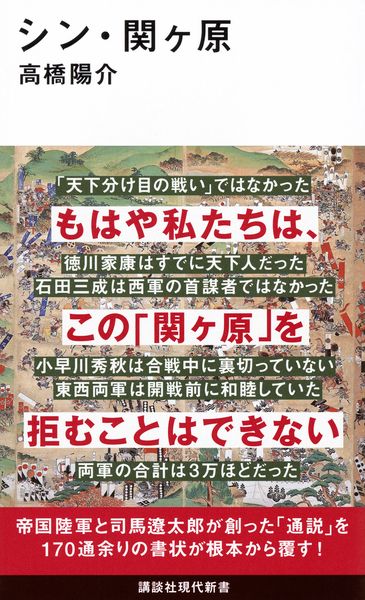
・According to a common theory, it is said that 150,000 people from both armies fought the battle that divided the country, but how many people actually fought; the Western Army was a group of Ukita/Shimadu/Konishi/Ishida, and the Eastern Army was a group of Fukushima/Kuroda/Todo in addition to Kobayakawa; by rough estimate, it is thought that a total of about 30,000 people from both armies fought (p265)
・The formation map handed down to future generations is fiction, and it is also an interesting story that the Western Army set up a battle with a crane wing and waited for the Eastern Army, but this is not true. Tamamura, where “Mount Sasao,” where Mitsunari Ishida is said to have set up his headquarters, is not the main battlefield. Also, the story that Tokugawa Ieyasu took the lead on the battlefield is untrue, and the Western Army should have already been crushed by the time Ieyasu reached the Sekigahara area (p265)
・Knowing the full details of the coup d'état by the Western Army, Ieyasu had a vision of ending this campaign through peace negotiations with Mori Terumoto when he began in August, and negotiation routes for those who were the leaders of the Western Army were also secured by this period. The Western Army, on the other hand, turned down the possibility of peace negotiations on its own by issuing a “law of differences between the Naifu” or by causing Fushimi Castle to fall due to a surprise attack, and the Western Army leadership did not have a plan to end the battle (p289)
・Regarding the battle of 9/15, the battle began because Ukita, Shimazu, Konishi, and Ishida of the Western Army headed for the Yamanaka area in an attempt to defeat Kobayakawa Hideaki, and the first thing that collapsed in the Western Army was Otani's army, but the author raised the issue that this had nothing to do with Kobayakawa Hideaki's betrayal, and furthermore, Ieyasu was already a person of the country before the Battle of Sekigahara (p293)