・Philosopher Arent points out that in many Western languages, work can be divided into two types, “work” and “labor,” the word work contains the positive meaning of people using their own hands and head to “work while devising,” and the word labor contains the negative meaning of people using their bodies to “work while struggling” (p81)
・Max Weber notes that Luther emphasized that “working in society is an act of serving God,” and Luther did not consider labor simply as a means of making a living, and gave positive religious value to that activity. What thoroughly followed this trend is Calvin's predestination theory, the idea that “whether people will be saved has already been decided by God,” and they began to seek confirmation that they were “chosen,” and what was taken as an external “mark” was an ascetic lifestyle and hard work in an occupation (p83)
・The Old Testament, which is the common scripture of Christianity and Judaism, stipulates that “interest must not be taken from poor compatriots,” and both Christianity and Judaism prohibited interest between compatriots (p99)
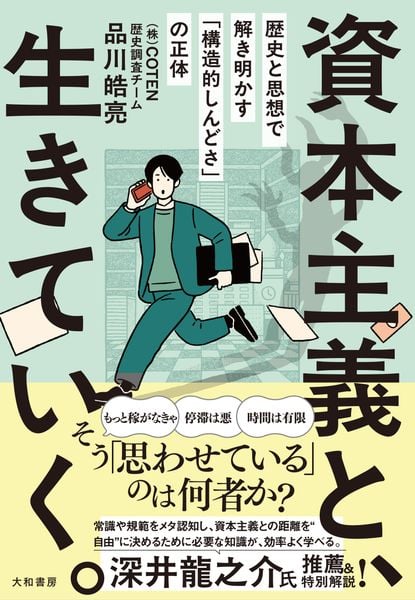
・The torn state of confusion where you don't understand your true desires is probably the true identity of the chaser called “consumption,” and the first step to escape from there is to set a distance from the heart that you want or want to do something and ask yourself “is that really my desire?” If you can cut down even 5% of what you usually buy or the time you spend on SNS due to this distinction, a small margin of mind will appear ( p124)
・Instead of completely denying or affirming capitalism, it is necessary to think with one's own head about how to deal with capitalism; this is an attitude that conforms to the “principle of balance” (p131)
・It can be seen that the six components of capitalism, division of labor, markets, commodities, capital, innovation, and finance create 6 followers (time, consumption, money, labor, growth, numbers) and are connected to our sense (pain) of being chased; division of labor, markets, and products are basic devices of capitalism; capital, innovation, and finance are accelerators of capitalism (p133)
・Productivity miraculously increases due to division of labor, and Adam Smith cites 3 points as factors: 1) proficiency is improved by one worker specializing in specific tasks, 2) saving time loss when switching tasks, and 3) inventing countless machines (p139)
・The reason why division of labor and time are linked is that division of labor aims to improve productivity, and the condition of “unification of time” is essential for the system to function, and when productivity is increased, everyone must start work at the same time and move at the same rhythm, in other words, the division of labor “has workers who are pressed for time” (p145)
・In the first place, it can be said that a market is a place where the interests of each individual are realized through the exchange of goods and services, and one of the differences between the state of commerce in medieval Europe and the market in capitalism is the premise of a free market without rules. Competition inevitably arises in a free market, leading to quality improvements and price declines, leading to consumer benefits, and there is “presence or absence of expansion of scale” as an even more important difference, and “market expansion” is an essential condition in order to develop division of labor and increase productivity (p153)
・As a result of a dramatic increase in productivity due to division of labor, production capacity continues to rise but people are faced with a situation where they already have what they need; at this rate, the market becomes saturated, companies go bankrupt, and workers lose their jobs. In response to this difficult problem, nations and companies carried out revolutionary shipping changes in the 20th century, which is “there is a limit to meeting consumer needs, then it is good to create the needs themselves.” It was a thing, and in this way, the market changed from a simple place to buy and sell products to a “device that produces desire,” and ignited feelings that it would be embarrassing without it and that you could be even more wonderful if you had this (p161)
・Marx thought that money was a special product with unique characteristics among all products that exist around the world. Before humans used gold etc. as money, they used various products as a means of displaying value, but that was inefficient; if they had what they wanted and couldn't meet someone who wanted their own products, the exchange they wanted would not be established, and it was very inefficient. To solve this, it is enough to create a unified value standard common to all products; for example, express all products with “rice.” In this way, only money has come to have a special power that should also be called “magic power” that can be freely exchanged for any product (p177)
・The answer to how the magic of capital is possible is “capitalists proliferate value by purchasing and consuming a product called labor,” and unlike all other products, only the product called labor has the power to generate new value. This discovery is an innovation in Marx's analysis of capitalism (p191)
・ Methods of communication and romance have also changed due to the spread of AI, and when many conventional occupations become unnecessary, the way job hunting and education are done will also change. Furthermore, there is a possibility that elections and even the state of politics will change in the future. Creative destruction is an event that has a major impact on society as a whole. This creative destruction is different from simple technological innovation; it has the power to fundamentally change the social structure itself. The advent of automobiles destroyed the horse-drawn carriage industry, and reformed urban structures, transportation systems, and even people's sense of time, and while many people lost their jobs as a result, new business opportunities were also born (p219)
・What exactly is a thing based on the desire expansion principle? In a capitalist society, people who produce more efficiently (division of labor = time), arouse consumer desires (market = consumption), work to raise higher surplus value (capital = labor), continue to generate higher added value (innovation = growth), achieve greater quantitative results (finance = numbers), and as a result create larger money (products = money) are evaluated as wonderful people (p263)
・The core of the “hardship” of living in a capitalist society is here, humans are beings that cannot be measured by such simple things, such as being able to make money, or being able to gather a lot of likes on SNS; we are more complicated and cumbersome, and that's why we are adorable creatures, but the yardstick of the desire expansion principle ignores the complexity and hassle of human existence and imposes simple and easy-to-understand indicators By being pulled by both this yardstick and our own voice as a human being heard from the depths of our hearts, I think we feel uneasy and impatient every day in capitalism (p264)
・The “feeling of being chased” by someone all the time was an impossible tense relationship between things created by a huge system called capitalism and the “value that cannot be measured” of us humans (p264)
・Regarding how to keep a distance from capitalism, when it comes to time, it is not time remaining to decrease, and regains a cyclical sense of time ・Doubts the assumption that time is not enough, lives like swimming in time · prevents internalization of time control, and time with loved ones brings value that cannot be converted into money (p273)
・As for growth, humanity has the courage to step down from the story of progress, and enjoy that moment with all its might ・Doubt thought patterns that regard maintaining the status quo as evil ・Self-aim taking a break and rest (p274)
・When it comes to numbers, understand the adverse effects of numerical management ・Check regularly to see if you're not obsessed with measuring ・Utilize financial power, but don't expect too much (p276)
・Regarding labor, it is also important to notice the internalization of the value that you have to work hard, search for joy in labor other than wage labor, such as creative activities, etc. ・Separate the assumption that you work is your true self ・Dismantle aircraft added to labor, and divide labor into difficult things (p277)
・As for money, in situations where you earn money, you live with a different standard of value in other situations ・Anything more than this is surplus, and if you have it, you draw the line that it's profitable ・Observe without making greed an enemy (p279)
・Regarding consumption, question the source of the feeling of wanting it・Being aware that SNS is a theater of consumption, it is necessary to devise ways such as leaving as soon as you get close ・notice the paradox of being forced to enjoy, and think that leisure and boredom are the greatest luxury (p280)