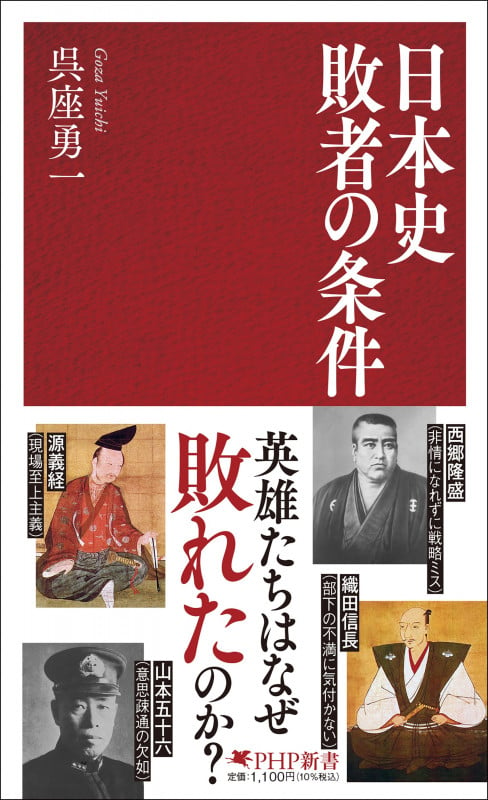
・Brilliant success is not necessarily based on a winning equation, and is often only supported by chance or good fortune; on the other hand, there is a clear cause for defeat and failure. If so, wouldn't it be more useful to use countless mediocre failures in history as teachers (p4)
・Minamoto Yoshitsune's direct military power was weak, but the reason Yoshitsune was able to defeat the Taira clan was none other than because he succeeded in rescuing the samurai in the Kinai and Western provinces, but that was not due to Yoshitsune's personal appeal. Yoshitsune was able to lead them due to the position of Yoritomo as daikan and the Taira clan memorial order by Emperor Goshirakawa (p36)
・The Seinan War initiated by Saigo Takamori in Meiji 10 was the biggest and last rebellion of the warrior class, and more specifically, Japan's last civil war. There was a big difference in military spending between the Saigo army and the government army (70 vs 41.6 million yen), and since the Saigo army did not have a navy, it was a battle where there was no way they could win considering common sense (p60)
・In Kagoshima, warriors who felt dissatisfied and returned to Japan after the Conquest of Korea coup took the lead; for this reason, Kagoshima prefecture was the only prefecture in the whole country, and until the Seinan War, they solidified the prefectural office with almost only local people and carried out unique policies, so it showed the appearance of an independent country (p63)
・Whereas the Saigo army was forced to use front-loaded Empire guns and Minières guns as the main axes, the government army possessed a considerable number of built-in snydle guns (capable of firing 6 shots per minute). The Saigo Army, which did not anticipate a large-scale shootout, began to struggle with ammunition replacement right after the war began (p72)
・The biggest factor that divided the victory and defeat of the government army and the Saigo army was naval power. The government navy mobilized 19 warships and 2280 officers and soldiers to participate in the war. The government army took advantage of the maneuverability, transportation power, and telegraph power of steamers to control the Saigo army's maneuverability and telegraph, and overwhelmed the Saigo army in terms of quantity (p78)
・Since Yamamoto 56 conceived a novel strategy and threw the execution of that operation to the scene, it can be concluded that the scene could not accurately understand Yamamoto's operational intentions, and the second strike of the attack on Pearl Harbor was easily abandoned (p97)
・The Japanese Navy's operational command system at that time had the flaw of having a two-story military command department and a combined fleet, and in modern terms, the combined fleet was a half-hearted organization sandwiched between the headquarters headquarters (military command department) and the site (task force). Therefore, Yamamoto's decision, who is the Commander-in-Chief of the Allied Fleet, was extremely half-hearted, neither headquartered nor on-site. Bringing Operation Midway into a decision in the form of overtaking the military command department based on the battle situation is on-site, but it is at the head office when Yamamoto ignored calls for the postponement of operations from task forces that were exhausted by continuous operations (p121)
・The financial situation of the Imperial Court, which was in jeopardy due to Oda Nobunaga's financial support, improved dramatically, and it was unthinkable that the Imperial Court was hostile to Nobunaga, and rather desperate to buy the patronage of Nobunaga, the sponsor (p127)
・The cause of Akechi Mitsuhide's defeat was that he was unable to respond quickly to a sudden change in the situation called Hideyoshi's Great Return to China. If the timing to steer to a partnership with Ashikaga Yoshiaki had been a little earlier, history might have changed. Oda Nobunaga was the top manager who asked his subordinates to report one by one, and Akechi Mitsuhide won Nobunaga's trust by asking Nobunaga for detailed instructions, and for Mitsuhide, who has had such experiences, it would have been extremely difficult to immediately make appropriate decisions as a top manager in response to situations that change moment by moment. Business people must write their own code of conduct in response to changes in this position from the standpoint of seeking judgment from their superiors to the position of making their own judgments (p145)
・Ieyasu fell into crisis due to the Western Army's occupation of Osaka Castle and the “rules of differences between the Naifu.” It is impossible to think that Ieyasu intentionally caused Mitsunari and others to raise an army, and in this sense Mitsunari and his team raised an army at Ieyasu's fault, and Mitsunari's ability, which seems to have devised and directed the operation, should be properly evaluated (p167)
・As a result theory, it was a failure for Ishida Mitsunari and others to leave Ogaki Castle; the Western Army, including Mori Motoyasu, Kobayakawa Hidekane, and Tachibana Muneshige captured Omi Otsu Castle on the day of the Battle of Sekigahara; if Mitsunari hadn't rushed to a decisive battle with Ieyasu, they would have taken a system to attack the Eastern Army such as Ieyasu at Otsu Castle and Ogaki Castle. If this happened, Ieyasu must have fallen into a tight spot (p179)
・The Western Army was described as the “Ishida-Mori coalition government,” but such an erratic power structure was the Western Army's greatest weakness. As a result, the Western Army took a great deal of time to make decisions, and they always took a back seat in response to Ieyasu's agile movements. It seems that Mitsunari was not deeply aware of this weakness, probably because he was used to an environment where everything progressed quickly with the voice of Toyotomi Hideyoshi's crane; Mitsunari was able to play an active role in 12 minutes when there was a firm organization called the Toyotomi administration, but it must be said that Mitsunari was unqualified to lead and operate a new organization called the Western Army. Mitsunari's failure tells me that building an organization and establishing a decision-making process is important and difficult now and in the past (p189)
・The policy of Okitsugu Tanuma, which pursues the interests of only the shogunate, tells me that an ad hoc growth strategy without a grand design, which was stuck in response to fierce backlash from various quarters as a matter of course, is counterproductive (p209)
・Samurai families led politics in Japan after the Jokyu Rebellion. This is exactly samurai government; conversely, before that, it was not strictly a samurai government; the influence of the shogunate was extremely large, but the center of politics existed in the Imperial Court (p217)
・It is said that Nobunaga did not unify whether to display the size of his territory in terms of elevation (currency equivalent) or stone height (US equivalent), and followed local practices. Nukitaka display in Owari and Ise, and Ishitaka display in the Gokinai region and Omi/Echizen/Saikoku, etc., where as a general rule, only one lord and one cultivator are brought to a form where there is only one lord and one cultivator on one land (eliminating intermediate exploitation) is an early-modern government system, but Nobunaga did not aim for that. I didn't think about grasping and confirming Ishitaka through a land survey just by stealing the enemy's Tomoyuki and handing it out as a reward to allies and vassals. Since 70 years ago, the Hojo clan introduced a method of granting territory to vassals based on land surveys and determining peasants' annual contributions. He is more advanced than Nobunaga (p228)
・The Rakuichi Ordinance is a law that aims for market promotion by encouraging merchants to come to the market by prohibiting violent incidents involving transactions, exemption from sales tax levied on trading at the market, exemption from admission fees to the ground, etc., and it has been issued by many feudal lords. Nobunaga's originality lies in the fact that he created the catchphrase “Rakuichi Rakuza” by combining “Rakuza” with the traditional Rakuichi Code (p233)
・Nobunaga claimed “Rakuza” and denied the privilege of being a seat. It is now possible to do business freely even if they are not members of the seat. However, Nobunaga did not abolish Za in general; “Rakuza” was carried out only in specific markets, such as the Kano Market in Gifu and the castle town of Azuchi. There was Abura in Oyamazaki as the largest seat among the constellations, but activities have continued to be approved. The reason why Za had exclusive rights was that they donated money to shoguns, court nobles, temples and shrines, etc., and backed up their authority. If Nobunaga abolishes the seat of Kyoto and Nara, all the saving power of this region will be turned against the enemy. What was important to Nobunaga was not economic promotion, but the maintenance and expansion of the territory (p235)
・Nobunaga had a fatal flaw as being superior to others, and he was unaware of the dissatisfaction that current people had against him, and he assumed that he must be grateful for his dress. Nobunaga completely overused the people he selected, and when they were used up, he was demoted, banished, and purged. With this, it is natural for even people who have been evicted to be dissatisfied. Business managers, on the other hand, should use Nobunaga's employees as teachers in management positions (p244)