
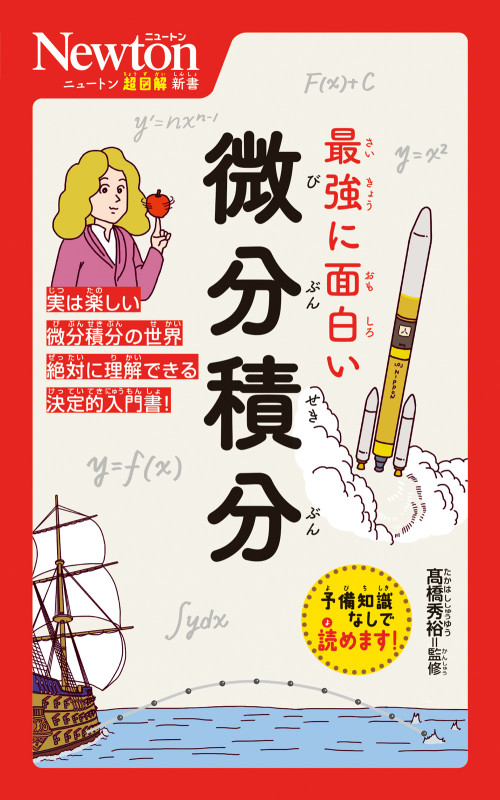
・Simply put, calculus is mathematics that calculates how things “change”; for example, it calculates where and at what speed a few seconds from the speed of the shell was fired, in other words, the future can be predicted by using differential integral calculus (p14)
・Isaac Newton, one of the founders of calculus, discovered differential calculus, a revolutionary mathematical method at the young age of 23 (p14) Newton went on to Cambridge University at age 18, and enthusiastically invited books by Galileo Descartes at university (p16)
・The tangent line drawn to the trajectory of a moving object indicates the direction of travel at each moment. An object drawing a parabola is about to move in the “tangential direction of the parabola” at each moment (p50)
・To draw a tangent means to “express a tangent with a mathematical formula.” In order to draw the correct tangent line, it is good to know the “exact slope of the tangent” (p59)
・The differential method created by Newton is an extremely powerful tool for accurately analyzing a changing world (p100)
・The problem of integration up to that point was solved at once by using the “inverse relationship” between differentiation and integration, and if you want to find the area on the lower side of the curve, there is no need to divide it into detailed shapes, and you can find an “atomic function” representing area (p152)
・Newton arrived at the basic idea of differential calculus in 1665, but he didn't announce it right away and only announced it at 1704 yen. Meanwhile, Leibniz compiled his own ideas into a paper and presented them in 1684. The British Royal Society, which is the current academic society, certified Newton as the founder in 1713 because Newton was the president (p167)