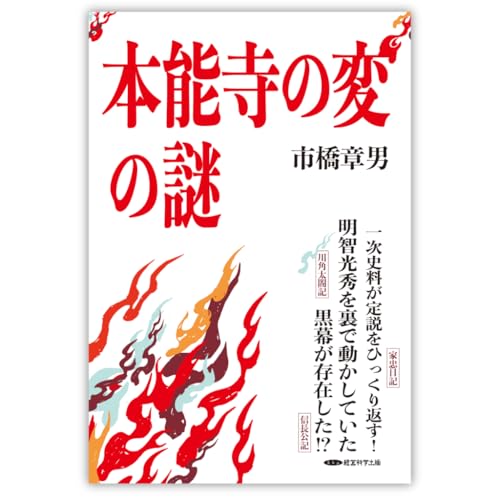
・ “Takeshi” does not mean fighting; it is about stopping a fight (). Tenka Fubu, which Nobunaga was talking about, said, “I'll stop the fight already.” It has been often said in recent years that the seal “Tenka Fumu” left by Nobunaga is to once again make the whole of the country = Kinai a peaceful land while trying to revive the Muromachi shogunate, and that this may have been the aim of Nobunaga's “Tenka Fumu” seal (p16)
・Even now, a golden statue of Nobunaga stands in front of the station in Gifu, and it seems to symbolize Nobunaga when the superior Takeda clan disappeared and was freed (p21)
・Ieyasu left Kyoto on 5/29, and Nobunaga entered Honno-ji Temple in the afternoon of this day. The day after 5/29 is 6/1, but at that time it was the small month according to the Japanese calendar, and the small month only lasts until the 29th. The big moon lasts until the 30th, and once every 4 years there is a year where the moon comes twice (p24)
・Ieyasu stayed in Kyoto for 7 days, and it is likely that he was detained in Kyoto. Sakai was an attractive city where rare things from around the world came in for warlords at the time, which meant not to go to Sakai too early. It's strange why it was rounded up in 2 days even though I went all the way to that society (p42)
・Honno-ji Temple, which was a devotee of the Nichiren sect, is also a Nichiren sect, and the reason is why he sang the Nichiren sect, but it seems that originally there was a landowner from Tanegashima who transmitted guns to one of the big parishioners at Honno-ji Temple. Ieyasu stayed at Myokoku-ji Temple, and the first place where his eldest son Nobutada stopped during the Honnoji Incident was Myokaku-ji Temple (p48)
・Even now, there is a stone statue of Akechi Mitsuhide behind Sakamoto Castle, but if you read “Akechi Family Law,” which is a splendid stone statue, you can see that “the family vassals, who were favoured by Nobunaga and were excessively thankful, were vassals who asserted that Nobunaga must not forget to serve Mr. Nobunaga until their descendants,” and were extremely loyal vassals (p53)
・If you look at the “Chronicles of Kotsune” written by the court nobleman Yamashina Kotsune, there is a saying that Nobunaga died right away, and he died in a fierce battle with Nobutada (p76)
・The famous phrase “by all means falls short” is not a word showing Nobunaga's cleanliness or determination, saying “it's ridiculous, there is no right or wrong, it's something that should not happen” (p77)
・At the time of the Honnoji Incident, Akechi Mitsuhide took control of Tamba Province after suffering, and at the same time, Hosokawa Fujitaka of Tango Province, Tsutsui Junkei of Yamato Province, etc. were assigned as forces under Mitsuhide, and he rose to the position of number one in the Oda family, making him a total commander of about 2.4 million koku (p93)